Showing posts with label Photographs. Show all posts

Friday, 1 April 2016

Writing For Orca: Hello from Suzie!

by Suzie Hall 

Hello - my name is Suzie Hall and I am Orca Aware's new blog writer! 

Like so many, I watched the beloved Free Willy when I was just a few years old and have been completely captivated with orca ever since. I adopted Springer the orca at the age of 11, spent most evenings watching any orca videos and documentaries I could get my hands on, and even emailed SeaWorld when I was ten years old wanting to become a trainer (until I learned about the poor welfare suffered by orca in captivity).

As I grew up, there became a point where I had to try and establish if my love of orca was ‘just a childish phase’ (because, let’s face it, who doesn’t love whales and dolphins as a kid!?), or whether it was built on something more. At University I joined the SCUBA diving society and suddenly my passion for the ocean, marine conservation and orca exploded into life. I am now certain that it’s not just a fad, and I’m confident that I have a long life of orca-related endeavours ahead of me.

Last January, I travelled to Grundarfjörður, Iceland on a three-day orca-watching trip. The area is famous for the huge shoals of herring which visit in the winter months, attracting orca and other cetaceans (whales and dolphins) in their hundreds. Unfortunately, the winter season in 2015 was uncharacteristically lacking in herring, and the fish that often flood the fjords were nowhere to be seen. And neither were the orca. On our third day the boat captain received a call that there were orca right near the tip of the Snæfellsnes peninsula (about 30km away) and we were taken on a huge three-hour round trip in an attempt to find them, but sadly to no avail.

Our orca watching boat with Laki Tours, Grundarfjörður (Photo © Suzie Hall)

It has always been my dream to finally see these magnificent animals in their natural habitat, and what surprised me the most is that I wasn’t disappointed at all that we hadn’t seen them. I was hugely content in the knowledge that the orca were out there swimming, hunting and playing wherever they liked; that was much more important than my own personal experience.

My trip to Iceland has kick-started my drive to learn and do more for orca. At the dive conference last October I met the members from British Divers Marine Life Rescue (BDMLR) and very quickly the conversation turned towards orca (this happens quite a lot!) and I explained how I want to get involved in any way I can. Now I find myself writing for the BDMLR sponsored campaign, Orca Aware and can’t wait to get started!

Suzie trying on BDMLR's orca costume
I am constantly inspired by the tireless work of orca advocates worldwide, and I hope that one day I too will be able to make a contribution. Why such a strong connection to an animal I have never encountered? In truth, I have no logical answer. It is, admittedly, quite strange and perhaps I’ll never be able to explain it. All I can say is that I know my love for them will drive me to spend my life working to understand, protect and educate the world about these fascinating mammals.

My advice to anyone who loves orca and wants to get involved is simply just to go for it. I don’t have a marine-related degree, I have seen a grand total of four dolphins in my life, and I’m living in a completely landlocked city – but that won’t stop me. There are still a shocking number of orca in captivity, our own resident population in UK waters (the West Coast Community) is in danger of extinction and there is still so much we don’t know about orca worldwide. There is a lot to be done for the protection of this species and so many things that people can do; so get started!

In the meantime, I will look forward to bringing you my take on the latest news and information in my up-and-coming Orca Aware blogs. Thanks for reading and please get in touch if there are any topics you would like me to write about! 

Sunday, 9 March 2014

My Icelandic Orca Saga

by Sam Lipman 

Iceland is not what I expected. There are countless beautiful wonders to behold, with breath-taking scenery at every turn, abundant wildlife and a deep, rich culture full of history and magic. It's less icy than I thought it would be.

Standing at a geyser location on the Golden Circle route

My knowledge of the country was incredibly limited prior to my visit and much of what I knew was not positive. I was aware that whaling still occurs in Iceland and I knew that the captivity industry had plundered Icelandic waters, capturing orca in the 1970s and 1980s. That was about the extent of it.

There are currently (at time of writing) only eight of the 55 known Icelandic orca captured that are still alive today. The 47 unique individuals who have since died each shared similar stories; they were captured as young calves, sent to different display facilities around the world, with many dying soon after, and did not - with the exception of one orca - swim in open ocean again. (You can find out more about the Icelandic Orca in Captivity).

Four of these orca, (Keiko, Tilikum, Freya and Winnie), and their journey has particularly resounded with me, leading to the Icelandic orca being a special population for me. It was Keiko who first sparked my own journey that sees me here today, writing about Icelandic orca for a campaign that I founded, which is all about orca. Winnie, Freya and Tilikum too have all made a profound personal imprint that has shaped my life, work and passions. 
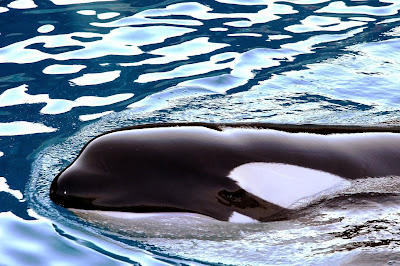
Freya at Marineland Antibes in France (Photo © OrcaGirl)

I arrived in Iceland on Sunday 16th February. During the coach journey from Keflavík International Airport to the capital city of Reykjavík, I was sat beside my friend and fellow orcaholic Rob Lott (orca programme lead & policy manager with WDC). A short distance from the airport, Rob pointed to a small, nondescript shed through the window. He told me that during the capture years, the shed had been used to hold newly caught orca calves, before they were transported out of the country to marine entertainment parks in other parts of the world. It hasn't been used for that purpose for at least 24 years when the live captures ended in 1989 (the year I was born), but I still felt a shiver run up my spine. It is a tiny warehouse with only a few small windows. And it is tauntingly close to the sea. 

Knowing that young orca had been kept inside the shed left me feeling uneasy. I didn't want to imagine how confused, frightened and stressed they must have been. 

This shed would have once held wild orca (Photo © Rob Lott)

As we approached the city, I learned about the whaling that still takes place in Iceland. There are only two or three small whaling companies, with only a handful of people involved (one of whom is a considerably powerful figure). The whale meat is sold as pet food, for human consumption in some restaurants and dead whale is used by one Icelandic brewery in its beer. Only around 5% of Icelandic natives eat whale. The majority of whale meat sales in restaurants are to tourists, many of whom are under the impression that eating whale is part of the Icelandic tradition. This is a fallacy as whaling has only been occurring in Iceland since the 1950's. The IFAW 'Meet Us Don't Eat Us' campaign is working to raise awareness about this issue. (If you are planning on visiting Iceland, you can look for the 'whale friendly' sticker on restaurant and hotel fronts before choosing to take your custom there). 

I enjoyed my first night in Iceland, where I saw my first glimpse of the aurora. Still, I couldn't get to sleep fast enough as we were travelling around the Golden Circle (to see magnificent waterfalls, geysers and frozen rivers) and on to Grundarfjörður the following day, in the hope of encountering wild Icelandic orca.
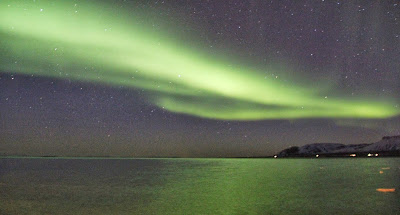
The Aurora Borealis over Grundarfjörður (Photo © Sam Lipman)

My time in Grundarfjörður, which is located on the Snæfellsnes Peninsula in the west of Iceland, was full of orca. Where my knowledge of Iceland had been somewhat lacking in those first few days, I had known a little more about the Icelandic orca population through my research for Orca of the World

The Icelandic orca are of the Type 1 Eastern North Atlantic ecotype and they feed primarily on herring. The Icelandic catalogue currently contains 226 individuals, and five of these have been sighted in waters around the Shetland Islands, off mainland Britain. Orca research in Iceland began in the 1980's but studies off the coast of Grundarfjörður are more recent. There is still a lot that is not known about these orca. 

During my stay, I attended fascinating lectures presented by orca experts Erich Hoyt (Far East Russia Orca Project) and Filipa Samarra (NAKID & Icelandic Orca Research), as well as talks given by several other individuals working in the field of cetacean conservation and education.

Icelandic orca (Photo © Sam Lipman)

My first sighting of the orca was from land, standing at the back of the hotel. They were way, way out across the fjord and I could only just make out the tall dorsal fin of a male. The boat trip I was about to head out on with Láki Tours (the only whale-watching company in Grundarfjörður) had been brought forward due to the sighting, so there was a mad dash to get back to the hotel to collect cameras and wet-weather gear. 

It was a glorious day with clear skies and calm seas. We were fortunate enough to spend several hours out on the water with the orca, white-beaked dolphins and numerous sea birds. The boat took us into the bay of Grundarfjörður and round to Kolgrafafjörður, the adjacent fjord, where there is a bridge the orca have only this year starting swimming under.  
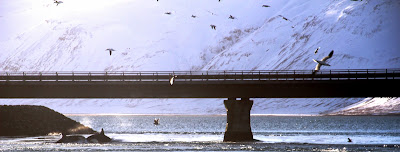

Orca swimming under the bridge in Kolgrafafjörður (Photo © Sam Lipman)

Seeing the orca from the bridge is an entirely different experience to watching them from the boat. It must be one of the best land-based whale-watching spots in the world. We were incredibly lucky with our encounter. Firstly, our bus to the bridge pulled up just in the nick of time as the orca were swimming underneath. Secondly, the orca passed backwards and forwards under the bridge several times, which is not typical behaviour. 

Standing on the bridge, around 20 feet above the waters surface gave me the unique perspective of watching the entire orca form as each individual swam, surfaced and dived right below me. It is a fantastic way to be close to the orca without invading their environment or interfering with them in any other way. 

Moving deeper into the fjord after passing under the bridge (Photo © Sam Lipman)

The Kolgrafafjörður bridge was a great place to digest the surrounding view and to really appreciate the orca in the context of their natural environment. I couldn't help but compare the wide, open space to the small, plain tanks that the captive Icelandic orca are living in. I tried to imagine what it must have felt like for Keiko to experience open waters again after many years in a concrete swimming pool; going from such a tiny, cramped box to such a huge, deep expanse. 

My thoughts were similarly mixed as I watched a young calf surfing alongside his family. I felt privileged that I could watch the pod and I couldn't believe anyone would want to break up such serene, purposeful existences. 

Female and calf surfacing in Grundarfjörður (Photo © Sam Lipman)

The Icelandic weather is, as I discovered, like the nature of orca: wild and unpredictable. Rough seas meant that we could not always get into Kolgrafafjörður by boat, or even out on the boat at all. There are also fewer orca inhabiting the waters around Grundarfjörður this year in comparison to other years. This made the encounters I did have with them all the more sweet. Yet, I can't help but wonder where the orca go and if they are leaving to follow the herring. 

While the orca were at times elusive, the white-beaked dolphins were around most days. On one orca-less day, I was lucky enough to encounter the dolphins feeding from a large bait-ball (a swarm of small fish), sharing their catch with the sea birds. During the feeding frenzy, a small calf decided to explore the waters around the boat and spend a little time people-watching. Compared to orca, the largest of all dolphins, these white-beaks were much faster and more agile. They would often approach the boat, swimming around it, bow-riding, and leaping clear of the water. They were a very different and enjoyable species to watch.


White-beaked dolphin and sea bird fishing (Photo © Sam Lipman)

White-beaked dolphin calf (Photo © Sam Lipman)

As my time in Iceland drew to a close, I started to reflect on my experiences watching the Icelandic orca. They are the third population and ecotype I have encountered and, while in many ways they remind me of their distant fish-eating cousins, the Southern residents, the longer I watched them, the more I also began to notice some possible similarities to the New Zealand population. 

The Icelandic orca appeared to be quite curious about the whale-watching boats, changing their course and surfacing unexpectedly by them, as well as seemingly taking quick glances at the people on board. They also seemed to be aware of activity on the bridge and occasionally showed an apparent interest in the people watching them, turning onto their side and spy-hopping to get a better look. Perhaps with there being just two whale-watching boats that take trips out into the fjords, and with this being the first year they have started passing under the bridge, these are novel additions to their environment. Perhaps they recognise the boats. Or maybe they find us as interesting as we find them. 

There is still so much that we do not know about these and other orca living in our oceans. I very much look forward to the future knowledge that we will gain through responsible and respectful research. And I look forward to the next population that I will encounter... whoever they may be!
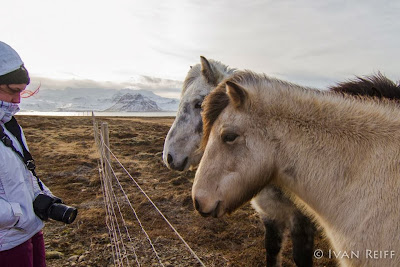
Sam with Icelandic horses (Photo © Ivan Reiff)

A big thank you to Rob Lott (Rob's WDC blog), Cathy Harlow (author of the Iceland Landmark Visitors Guide), Alexa Kershaw (Alexa Kershaw Wildlife Photography) and the team at Láki Tours for their vast knowledge, energy, passion and determination to find the orca! 

For more information, visit Orca Aware: Icelandic Orca.

Friday, 21 June 2013

See No Orca, Love No Orca?

by Naomi Mitchell (guest blogger) 

I had never seen an orca in the flesh until last summer. In search of whales, wilderness and escape, I spent a blissful 4 months on the west coast of British Columbia, where I found all three. But my passion for killer whales started many years ago...

At age 7, I watched a well known and much-loved film about a captive killer whale who is given back his freedom. Captivated by their intelligence and thrilled by the excitement of the film, I instantly fell in love with these majestic black and white giants! Fast forward 10 years and I was to be found training to be a Marine Mammal Medic with British Divers Marine Life Rescue, hoping that it would give me some more insight into the mysterious lives of marine mammals. It is hard to put into words how, but despite having still never seen a live whale or dolphin in my life, they had managed to steal my heart and capture my imagination. At this point, I probably would have jumped at any chance to see these animals, be it in the wild or captivity.

Northern Resident orca from the A30 matriline (Photo © Naomi Mitchell)

Several years later, studying Animal Behaviour Science at university, I took every opportunity to bring marine mammals into my coursework even though my degree focused mainly on domestic animals. When I was finally offered the chance to swim with captive dolphins in Dubai for my birthday I already had an uneasy feeling - and a little further research quickly made me realise that this wasn't the most amazing birthday present ever. It was probably the worst. And having realised this in time, I didn't do it. But I did do more and more research into the subject and it soon became clear to me that all cetaceans - and especially killer whales - should not be kept in captivity. I will always remember finding the minimum tank size requirements for the first time and after a few calculations deciding that it is equivalent to a human living in a small touring caravan, unable to leave, for the rest of their life. When you realise that wild cetaceans can swim vast distances in relatively short time periods, it is blindingly obvious that this is inhumane.

A year after graduating from university, a number of significant changes in my life led me to pursue the dream that had been lurking in the back of my mind for some time. So I booked flights, packed my bag and headed to Quadra Island, a small island nestled between mainland British Columbia and Vancouver Island, Canada. Just a matter of hours after arriving I had my first encounter with killer whales. A group of three Southern Resident pods took a route coming down the inside of Vancouver Island and right past Quadra. If I had loved and wanted to see killer whales before I arrived in Canada, it was nothing compared to how I felt after I saw them for the first time. I might have already ticked off number 1 on my 'to do' list, but I was hooked and I absolutely couldn't wait to see the whales again. Next time I vowed not to forget to pick up my binoculars in the rush!

Southern residents, Quadra Island (Photo © Naomi Mitchell) 

I did have to wait a few more weeks for my next encounter, but these weeks were filled with wonderful experiences and sightings of black bears, seals, sea otters, Pacific white-sided dolphins and humpback whales! And so those weeks flew by until one evening, camped on a beach on Hansen Island, looking out over the Johnstone Strait, I watched the first of the Northern Residents who had returned to the area for the summer. Over the next couple of months I was lucky enough to have some close-up encounters with several pods of Northern Residents, watching them from campsites, from boats and even from a kayak and listening to their fascinating calls on a hydrophone. Although just as magnificent in their own way, they seemed somewhat more reserved that the Southern residents who I saw engaging in more lively behaviours such as breaching and tail slapping. I was also lucky enough to see the more elusive transient killer whales on one occasion. Each encounter was thrilling in it's own way, but my favourite was when a young Northern resident decided to change course and headed towards our boat to investigate, passing right underneath!


Northern Resident orca viewed from West Cracroft Island, British Columbia 
(Photo © Naomi Mitchell)

Part of the magic was meeting other people from across the world who held the same dream as me: to see wild killer whales. There is nothing like the thrill of hearing a blow in the distance, and sharing the excitement of those around you makes it even more special. I think that my own experiences, and those of the other people that I met go to show that you do not need to see these animals in the flesh to love them and want to protect them - we all already knew that they were special or we would not have made the journey to witness this for real. My experiences with orca have been amazing and I have been incredibly lucky to see them. Seeing them in the wild confirmed what I always suspected about these magnificent animals, but my love for them has always been there.


Transient orca (Photo © Naomi Mitchell)

Tuesday, 27 November 2012

Encountering Orca: The elusive Type Ds

by Jamie Watts (guest blogger)

02 November 2012 - On the way back from South Georgia towards the Beagle Channel, just coming onto the shelf near Isla de las Estados, a very nice surprise. Delphine announces 'orcas' before breakfast. Up onto the bridge, and there they were - a little way off, a group of three, then further ahead and further over another small group. All heading northwest, all travelling, but in no particular hurry. 

Straight away they looked different. Very pointed, slightly swept back dorsal fins, lots of black, moderately sized for orcas. Then the flash of white above the eye – tiny. I doubt myself at first but after a couple more breaths from the other orcas it’s very clear. Type Ds.  Jet black backs, gorgeously pointed and swept fins, the rounded, pilot whale-like snout and tiny eyepatch – doesn’t look like any other orca.
  
Photo © Andrew Bishop

We always knew there was only one species of orca, found worldwide. Even after a couple of decades of intensive study particularly of the Vancouver Island and Alaska orcas, the huge differences between populations were just thought to be clan variations. In the meantime, soviet researchers in the Antarctic – where the majority of the world’s orcas are found – described two grey-backed forms as new species. It was the cold war, Russian research was either ignored or unknown in the west, and the type specimens of the new species were lost in a museum flood.

But in the last few years, the rather different Antarctic types have become rather well-known.  Most are smaller than the ‘regular’ orcas, and grey and cream rather than black and white, with large or slanted eye-patches. Their coloration and their proportions are rather different.

Photo © Andrew Bishop

Then we started getting genetic work done on orca populations - and there are rather large differences between populations. Even the Vancouver Island orcas are probably two entirely different species. Turns out we have in the Antarctic at least four different forms: Type 'A' big 'normal' orcas (which may further prove to be several groups), type 'B' - grey and cream with huge eye patches (there are probably two very different sub-types here, one large and one small), type 'C' - small, grey and cream, and with a slanted eye patch. And then there is the enigmatic type 'D'. 

Photo © Andrew Bishop

The Ds were only described in 2010. We have no genetic material, almost nothing on their behaviour. Researchers looking through photographic records found pictures of some very odd-looking orcas. Seven records, all around the edges of the Antarctic. Unlike every other orca, their snout is rounded like a pseudorca or a pilot whale. The fins are gorgeously sleek, sharply pointed and swept-back. And the eyepatch – tiny, a fraction of the size seen in other orcas.  They are almost intermediate between orcas and their closest relatives. They’ve been photographed seven times. Until this morning.

After breakfast, twenty miles away, a larger male and a couple more – again type D. I’d love to stop and somehow try and get some sloughed skin – something.  But we’re running tight on time. Ushuaia beckons.

You can see more of Jamie's work at www.jamiewatts.co.uk

Photo © Andrew Bishop

Thursday, 22 November 2012

My Orca Christmas Wish List

Dear Santa, I would like an orca for Christmas...

So I'm not sure Santa can stretch that far, or fit an orca through your chimney (or under your tree), and I'm not sure how Rudolph would feel about carrying a top predator behind his back. But we have come up with some great orca stocking-fillers for the orcaholics and marine lovers in your lives! 

Here are some of our favourites - click on the pictures to find out where you can purchase these items from! Remember, when buying DVDs check you have the correct region and format for your player. If any items are out of stock, or if you are not based in the UK, run a search for any item you are interested in as it may be sold by multiple retailers around the world. 

Books


Books For Kids


DVDs & CDs


Artwork & Calendars


Artwork by Leonard Boekee


Artwork by Uko Gorter


Clothing


Home Accessories


Jewellery 


Toys


Adopt-an-Orca


So we aren't going to wish you a merry Christmas just yet, but we will wish you a happy shopping! Let us know if you come across any other orca goodies that you think should be added to our letter to Santa!


Orca Aware Team