by Sam Lipman
“Let’s
Free Willy!” – Three simple words which awakened a dormant volcano of
controversy and sparked a flame of curiosity in the hearts of the general public.
The question on everybody’s mind: do the educational benefits outweigh the
implications of captivity on orca (
Orcinus orca), or are captive orca merely
prisoners of modern times?
A top
predator of the ocean and the largest orca currently in captivity, it is
difficult to believe that in November 1983, Tilikum was removed from his
family near Iceland, at the tender age of two.
For the
impact of this capture to be truly understood, we must look at the complex
social structures of wild orca. Scientific research into the study of orca
commenced in 1971, with pioneers such as Mike Bigg, Graeme Ellis and John Ford
leading the way; since this time biopsies have been analysed and photograph
identification catalogues amassed. Through recognition methods, it was possible
to observe the same orca repeatedly, giving insight into aspects of orca
behaviour.
Orca
groups found off the Pacific Northwest coast were the first to be studied. From
long-term studies they were categorised into three distinct populations:
resident (fish eaters, living in large, stable, matriarchal groups; Bigg et al.
1990; Ford et al. 1998), transient (marine mammal/cetacean eaters, travelling
in smaller, less stable groups; Baird & Whitehead 2000), and offshore
(about which, to this day, little is known).
 |
| Pacific Northwest transient orca (Photo © Josh McInnes) |
These
three genetically distinct groups of orca were also found to vary in social
organisation, behaviour, diet and appearance (Ford et al.
1998; Hoelzel et al. 2007). In 1970, John Ford used hydrophones to record orca
calls and discovered that orca pods can also have distinctive call repertoires –
they vocalise in different dialects (Ford 1991). These r
epertoires of vocalisations
and call-types are learned through mimicry and social learning, with some
evidence suggesting that repertoires are transmitted from mother to calf
(Ford 1991; Foote et al. 2006). Amongst
other findings, long-term studies also revealed that these orca remain with
immediate or close family relatives their entire lives, something which we now
know is the case for many other populations found around the world (Ford et al.
1998).
Dr.
Ingrid Visser, (founder and principal scientist of the
Orca Research Trust), has observed that orca found in New Zealand waters take
on different roles within their social organisations, such as that of
baby-sitting or hunting (Visser, 2000). And more recently, Emma Foster (Exeter
University, England), in collaboration with orca researcher Ken Balcomb’s
Center for Whale Research, has
found evidence to suggest that
prolonged life after reproduction in female orca may have evolved so that they
can continue to care for their older offspring, particularly their adult sons
(Foster et al. 2012).
So what’s
in a name? Orca are the largest member of the dolphin family, Delphinidae. It
has been found that dolphins are the only other mammals, apart from humans, to
use referential names. Dr. Vincent Janik (University of St. Andrews, Scotland)
carried out a study on a group of bottlenose dolphins (a close cousin of orca)
in Florida and found that infant dolphins choose their own name, specific
signature whistles, which are used throughout their entire lives (Janik 2000;
Janik et al. 2006).
 |
| New Zealand orca (Photo © Sam Lipman / Orca Research Trust) |
There are
also physical indicators as well as behavioural which suggest that orca have more developed cognition and higher intelligence. The brain weight to spinal cord ratio of the bottlenose dolphin
is 40:1 in comparison to humans, 50:1 and apes, 8:1. Additionally, orca have a high brain
volume, increased brain convolutions in the cerebral cortex and highly
developed cerebral hemispheres (the part of the brain that deals with advanced
mental processes in humans; Williams 2001; Marino et al. 2004; Marino et al.
2007).
With the
meeting of the Bellerive Symposium on Whales and Dolphins in Captivity in
Geneva (1990), delegates concluded that “whales and dolphins are self-aware
beings that routinely make decisions and choices about the details of their
lives,” (Johnson ed. 1990).
As a
result of these complex social structures formed by wild orca, as well as the
species' higher levels of intelligence, self-awareness, large size,
wide-ranging carnivorous nature (Clubb & Mason 2003)
and long life-span, aspects of the mental and physical health of captive orca
have raised concerns.
As
As self-aware beings living in an ever-challenging world, we know all too well the
problems that stress can bring to our daily lives. This type of stress is not
limited to us. Researchers in the early 1980s studied stress levels of four
bottlenose dolphins held at the National Aquarium, Baltimore. The dolphins were deprived
of adaption time and put straight into a performance situation. One died from
internal abscesses and bleeding ulcers brought on by the stress of increased noise levels
and close proximity to humans. The remainder also suffered from ulcers but
recuperated when placed in a quiet environment. However, when removed from that
quiet environment, the dolphins’ health deteriorated once more. It was found
that increased stress levels could lead to physical complications, (e.g.
ulcers), as well as behavioural abnormalities, (e.g. stereotypic, abnormal repetitive
behaviours), both of which correlated with abnormal blood and serum chemistry
(Gibbons & Stoskopf 1989).
(Interestingly,
the National Aquarium have recently spoken out against the taking of wild cetaceans into captivity for any purpose stating, "we at the National Aquarium plan to call on our peer institutions, scientists and other experts to review the relevance of current MMPA policies regarding the collection of cetaceans from the wild and collectively craft a new approach to all such practices.")
Stereotypic (abnormal repetitive) behaviours can carry a high health risk. Captive orca often chew on concrete tank walls and steel gates to alleviate stress and boredom. When displaying aggression to whales in other pools, they tend to bite down on and "jaw pop" through the gate bars. This contributes to worn and broken teeth, which can lead to the exposure of tooth pulp. Decaying pulp can form a cavity which leads to food plugging if left alone.
 "The reaction of the orca’s immune system to this plugging is to create inflammation and eventually a focus for systemic infection. Because of the relative youth of most captive whales, the roots of many of their teeth are immature, which makes a root canal procedure impossible. Instead, using a variable speed drill, trainers drill holes through the pulp and into the jaw via an endodontic procedure called a modified “pulpotomy.” This is an uncomfortable husbandry procedure for the whales, which have been observed refusing to participate by sinking down into the water, shuddering, or splitting from their keepers. After “tooth drilling” is complete, trainers must irrigate (flush) the bored out teeth two-three times each day, for the rest of the orca’s life, to prevent abscess, bacteremia, and sepsis. (Kalina’s reported cause of death, “acute bacterial septicemia,” should make one ponder how bacteria entered her bloodstream." (Jett & Ventre 2011)
Although
conclusive links cannot be made between the mental health of captive orca and
any aggression exhibited, there have been instances where individuals have
caused physical harm to themselves, other orca and, as most recently shown,
humans.
“In 1991,
in Sealand of the Pacific, Canada, a female trainer, Keltie Byrne, was drowned by three orca
whales, one being a 5 tonne male named Tilikum, when she fell into their tank.
In 1999, in Sea World, Florida, a 29-year-old man, Daniel Dukes, was found dead, draped over
the back of an orca – Tilikum.” A quote from an essay I wrote for my AS Level
Biology module in school. Little was I to know that I would soon have a third name to add to Tilikum’s fast-increasing list of human victims (and not forgetting Loro Parque trainer, Alexis Martinez who lost his life to SeaWorld-owned
orca Keto in Tenerife in December 2009, just two months prior to Brancheau's death).
Dr. Paul
Spong has been researching orca for over 40 years. He maintains that
aggressive behaviours may result from sensory deprivation. Orca are kept
in cramped conditions, with little visual distraction. They are unable to hone
their hunting skills as live fish cannot survive the chemically-altered water
(and would also detract from the use of dead fish as behavioural reinforcement) and
the concrete tank walls interfere with orca echolocation, their primary sense.
 |
| SeaWorld trainer rides on the back of Northern resident orca Corky |
If kept
on their own, they lack social stimulation and if forced to create associations
with other orca that they would never mix with in the wild, aggression may be
displayed (bearing in mind that rarely have wild orca been observed to act so
aggressively towards one another as they do in captivity). For example, not
only would a wild resident and transient orca never associate, but they don’t
even share the same dialect. Other incompatibilities also arise when forcing
associations with orca, such as hierarchy conflicts within a social structure.
In 1989, captive orca Kandu rammed into Corky (two females from two different
populations), at SeaWorld San Diego.
Kandu died a slow, prolonged 45-minute death from
sustained injuries in front of a stadium full of members of the public
(Williams 2001). There just isn’t the space in captivity for orca to escape one
another during hostile or aggressive situations.
 |
| Wild Northern resident orca (Photo © Jeff Friedman) |
Corky is the oldest remaining wild-caught orca in captivity. Captured from the waters of British Columbia, Canada, she originated from the Northern resident A5 pod. She has lived in captivity for over 40 years. Dr. Paul Spong is founder of the ‘
Free Corky Campaign’ and the
OrcaLab research
project which focuses non-intrusive acoustic and other observation studies on the Northern resident orca found in Canadian waters. Originally beginning his career researching orca in captivity, Dr. Spong's findings led him to conclude that orca are not suited to life in an artificial environment.
Other wild-caught orca which are still alive in captivity
today include Southern resident orca
Lolita, Icelandic
orcas Tilikum, Ulises, Stella, Kasatka, Katina and Kiska, Argentinean orca
Kshamenk and most recently captured, Norwegian orca
Morgan, Russian orca
Narnia and c.
twelve more orca from Russian waters.
No orca
have been held captive in the United Kingdom since 1991 when the Department
of Environment (DOE) reviewed standards and conditions of captive
facilities. Revisions were made and even facilities as large (and as
profitable) as SeaWorld do not meet with pool depth requirements for tank size,
as set out by the UK’s DOE (Williams 2001).
It is
argued that the educational benefit of captivity for us as humans is worth the
captivity of orca. However, former world-renowned dolphin trainer Ric O’Barry
clearly stated on CNN that the education and research which comes out of
SeaWorld is a lie. Ric O’Barry trained the dolphins on the 1960’s hit TV series
‘Flipper’ and is now one of the biggest activists in returning captive whales
and dolphins back into the wild.
 |
| Icelandic wild-caught Freya (Photo © OrcaGirl) |
Educational
systems of profit-making marine amusement parks appear fundamentally flawed due
to commercial obligations. In the past, SeaWorld has provided educational
material which states that wild orca live between 25-35 years. Now, they claim
that “
no one knows for sure how long killer whales live”. However,
scientific research has estimated that female orca have an average lifespan of
50.2 years (80-90 years maximum longevity) and male orca have an average
lifespan of 29.2 years (50-60 years maximum longevity; Olesiuk et al. 1990).
This data for wild orca life-expectancy is widely accepted in the orca research community,
so the question begs to be asked, why will SeaWorld not accept it? Does it have
something to do with the greatly reduced median 2.7 - 8.9 year life-expectancy for captive orca (Jett & Ventre 2011)?
Furthermore, two
scientific studies from the mid-1990s show that there is a 6.2% annual
mortality rate for captive orca as opposed to the 2.3% for wild orca (all
studies excluding calves; Olesiuk et al. 1990). This has negative implications
for any orca-owning business and so some choose to dismiss scientific
publications, such as those reporting on wild orca longevity, because the facts, figures and statistics do
not concur with their own circumstances.
In 2006, SeaWorld's 'Ask Shamu' Team
stated in an email, "There are some people who claim killer whales live 80, 90 even 100 years old, but it is important to note that such claims are not backed by any scientifically documented evidence
as far as we know." That explains it then - they just didn't know about the Olesiuk et al. (1990) paper published 16 years prior and cited by a further 195 articles. Surely it would be responsible to read everything there is to read about orca before buying one? (SeaWorld currently owns the majority of the 57 orca currently held in captivity).
When
George Millay, founding father of Sea World, stated in 1989 that, “SeaWorld was
created strictly as entertainment. We didn’t try to wear this false façade of
educational significance,” his poignant, predictable words merely emphasised
the intentions behind taking these large, social creatures from the wild and
placing them in captivity. The amendment to the American 1989
Marine Mammal Protection Act (MMPA) of 1972 meant that all U.S. marine parks had to introduce an
educational facility (Williams 2001). However, further amendments to the MMPA in 1994 meant that the industry could largely self-regulate. (Now, what would be your thoughts if I said let's ditch
Ofsted and let our schools inspect themselves?).
If you go
onto the
Hubbs-SeaWorld Research Institute website and click onto the
publications tab, only two of the 140+ papers listed has anything to
do with enhancing our understanding of orca. And of those two papers that
are related to orca, one investigates killer whale reproduction at SeaWorld
(Duffield et al. 1995) and the other study explores aspects of growth in
captive killer whales (Clark et al. 2000).
Are
either of these studies applicable to the conservation of wild orca and their
natural habitat? And if so, do orca follow the same growth patterns in the wild
as they do in the much smaller confines of an artificial, captive environment? Furthermore, can findings about captive orca reproduction be applied to wild orca when,
for example, orca in captivity are breeding at a much younger age and a much
faster rate than their wild counterparts?
In the wild, females become sexually mature at around 12+ years of age (just like we do). They typically produce a calf every five years. In captivity, females are reproducing from as young as eight years old and are also producing calves at a much higher rate than one every five years.
I continued my
literature search for SeaWorld killer whale publications with
Google Scholar (search term: SeaWorld Orca). The top result was the 1995
Duffield et al. paper, the second result was a study of the behaviour and
training of a killer whale at San Diego SeaWorld (Burgess 2007). The third
listing was the Clark et al. paper on captive orca growth, the fourth study
focused on environmental enrichment at SeaWorld (Kuczaj et al. 1998) and the
fifth paper was about nursing parameters in captive killer whales (Clark & Odell 1999).
Of the 30 results showing on the first three pages of the search:
- At
least one third (10/30) of the publications were not produced by SeaWorld.
- Almost
half (12/30) of the results listed had nothing to do with studies on
captive orca (rather they were investigations into the educational
value of SeaWorld, reviews of the history of SeaWorld, investigations
into SeaWorld’s keeping of orca in captivity or articles reporting on
incidents which took place at SeaWorld, such as journalist Tim
Zimmermann’s “The Killer in the Pool” which documents Tilikum’s history and investigates the circumstances surrounding Dawn Brancheau’s death).
- Only
13 out of 30 listings were published post-2000, of which only eight papers were published either by SeaWorld or relating to SeaWorld orca. Of
these eight papers, five related to training and husbandry (e.i. artificial
insemination, reproduction, care and feeding in captivity). Of the other three
remaining papers, one investigated a fungal (zygomycotic) infection in one
orca held at SeaWorld Texas, one was the Clark et al. (2000) paper on
growth and one followed the sleep behaviour of new mothers and their
calves in the captive environment.
- Of
the 30 results listed, almost one third (9/30) were pre-1990.
I changed
the parameters of my search to “SeaWorld Orcinus Orca” and “SeaWorld Killer
Whales” and all this achieved was to push papers that were produced by SeaWorld
or that related to SeaWorld orca further down the results list. Adding in
“Hubbs” to the mix only does the same.
I
carried on with my pursuit of SeaWorld produced papers and my search brought me
to SeaWorld's Conservation & Research webpage. Of the seven sub-pages, orca only appear
under one: Reproductive Research Center. This department's primary research appears to be centred around artificial
insemination (AI). Of their primary publications, only three have
anything to do with orca (all of which cropped up in my Google Scholar search). The majority relate to artificial insemination in captive orca and so do not have any relevant application to wild orca - a 2004 Robeck et al. paper on "reproductive physiology and development
of AI technology in killer whales", a 2006 Robeck &
Monfort paper on the "characterization of male killer whale sexual
maturation and reproductive seasonality" and a 2011 Robeck et al. paper on
"in vitro sperm characterization and the development of a
semen cryopreservation method using directional solidification in the killer
whale".
Update 1: One year on from writing this article in 2012, four more papers relating to orca have appeared on SeaWorld's primary publications page. They relate to zygomycotic infections in orca; ultrastructure of spermatozoa in orca; characterisation of the estrus cycle, breeding period and seasonal estrus activity of captive orca; and the last paper is entitled "Hematological and serum biochemical analytes reflect physiological challenges during gestation and lactation in killer whales". This latter paper is dated 2013, however the rest were all published in the early 2000's and one paper was even from the early 1990's. So it looks as though I don't need to make any amendments to my following comments...
I struggle to see how any AI or captive breeding "tools developed through ex situ research" can be "integrated into in situ population management and conservation strategies," as the SeaWorld Reproductive Research Center mission statement declares. I mean, can you imagine using this ex situ research tool on a wild 22-foot long, 12,000 pound male killer whale out in the open ocean?
Or this tool (an endoscopy) being used on a loaned SeaWorld orca at Loro Parque in Tenerife? (In fact, this male is Keto - the orca who killed trainer Alexis Martinez in December 2009 - two months before Dawn Brancheau was killed).
There was one final tab left for me to explore - the research team who work in SeaWorld's Reproductive Research Center. Team members are listed along with their credentials, a short bio and a list of peer-reviewed papers they have authored or co-authored. Of the six researchers and 97 publications listed, only nine have any relevance to orca. Of the nine papers, three were duplicated - meaning that only 6/97 papers involved studies on the captive orca SeaWorld keep. Out of those six studies, two did not appear in my Google search.
Update 2: SeaWorld has been busy modifying its research pages (perhaps this explains why it doesn't have time to conduct the actual research?). It no longer lists the 97 peer-reviewed papers that have been authored or co-authored by members of its research team. So where it has added four orca-related papers to its primary publications page, it has removed nine papers with any relevance to orca from its research team page. Not only does SeaWorld not seem to be producing any decent scientific papers that can aid the conservation of wild orca populations but it now seems to be losing the scientific papers it has published that are relevant to captive orca. What's going on?
Overall, (and increasing my Google Scholar search to 20+ pages) I could only find a maximum of 35 orca-related papers that SeaWorld has funded or been involved with in some way, and I could only find between 25 and 30 papers that SeaWorld has actually published.
So what have researchers at SeaWorld been doing for the last 50-odd years the entertainment franchise has been holding orca captive? Or since 1989 even, when the MMPA was brought in and marine parks were required by law to introduce "education" - that's still less than 30 papers on orca in 33 years, averaging less than one paper per year (0.91 per year over 33 years or 0.6 per year over 50 years), and bearing in mind that not all of these papers were studies conducted by SeaWorld on the orca it holds captive.
Maybe these SeaWorld publications just aren't easy to find? A Zoology student (who had open access to numerous journals through her university institute) wrote to the 'Ask Shamu Team' explaining that she would like to learn more about orca and asking which journals she would be able to find their publications in. SeaWorld's response: "Our research, in general, is not available for people outside the zoological society to read and review. Although we do an extensive amount of research there is little we can directly point you to." It looks like SeaWorld doesn't seem to know where it left its publications either!
To put this into some kind of perspective - since 1998 (that's 14 years), Dr. Ingrid Visser has published at least 22 peer-reviewed papers on orca. Not including reports, t
his works out to an average of 1.6 papers per year, many of which tell us everything we know to date about certain populations, such as the New Zealand and Papua New Guinea orca. In only the last eight years, the Far East Russia Orca Project has published nine papers. N
ot including the two Russian orca reports they have also released and content on Russian orca published in two books, that's an average of 1.13 papers per year.
Of course, there are some projects or individuals who won't have published so many papers on orca, but if we were to amalgamate all peer-reviewed studies published by wild orca researchers over the course of the last 50 years and the duration that they have been researching the 40+ wild populations spread throughout our entire World's oceans, studying individuals and groups who spend more than 70% of their time underwater, I am sure the worldwide team effort would amount to much more than an average of less than one paper per year (this being relative of course to the smaller SeaWorld team working with the much smaller and much more restricted populations of captive orca).
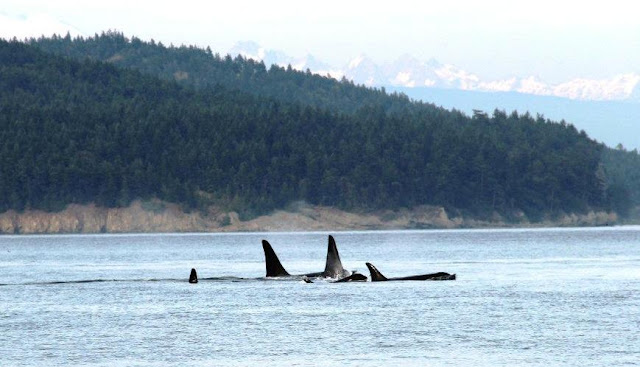 |
| Southern resident orca (Photo © Orca Aware) |
I spoke with former-SeaWorld killer whale trainer Dr. Jeff Ventre (MD), who had this to say about the research on captive orca that takes place at SeaWorld:
"Prior to going to medical school, I did two
tours of duty at 'Shamu Stadium' in Orlando, FL, USA in the late
1980's and again in the mid 1990's. During that time no research occurred. The
vets and animal training staff did spend time trying to figure out how to
manually extract semen from male killer whales (and eventually wrote a paper on
artificial insemination, AI) but it was only done to create more captive killer
whales. None of that work benefits wild animals. The other two scientific
papers that I am familiar with were written by SeaWorld veterinarians because
two young male killer whales died quickly from an unknown illness. As it turned
out, they were both killed by mosquito bites at ages 14 and 20. In 1990 the
transient male Kanduke died of St Louis Encephalitis, and in 2007, Taku died of
West Nile Virus. Whales in captivity spend many hours each night logging at the
surface, with their backs exposed. Mosquitoes, which are abundant in Florida,
Texas, and California, are attracted by the CO2 exhaled from the whales'
blowholes. Orca in captive environments are easy targets, unfortunately.
Confinement for them is both inhumane and immoral."
Dr. Ventre went on to briefly explain other health problems that captive orca often incur, "These large free-ranging mammals suffer from boredom, deconditioning, sunburn, and dorsal fin collapse, because of captivity. I've personally applied black zinc oxide to the dorsal surfaces of killer whales at SeaWorld to protect them from the suns harmful rays, and also to hide their peeling skin. The artificial pods, created by transporting animals from park to park, leads to social strife, and a host of other problems, including teeth damage and aggression."
The educational value of keeping these animals in captivity is questionable: who
are we trying to educate, in a century with fantastic television documentaries
such as those found on the Discovery Channel or on BBCs ‘Natural World’ series
or the hundreds of other wildlife documentary channels and programmes that are available to us? And of course this
is without mentioning other resources available to us in books and on the worldwide web. Or the fact that nowadays it is just as cheap, if not cheaper, to go and see orca in
their natural habitat in comparison to the high cost of seeing them in a captive facility such as
SeaWorld.
“What are
we teaching our children?” Dr. Visser asks about facilities like SeaWorld. “That it is ok to keep these
self-aware animals in captivity; that it is ok to keep them purely for our
entertainment and profit. And at what expense? A woman’s life has ended
and a proud, wild animal’s life remains destroyed.”
And what
are we learning ourselves? From observing internet forums and discussions, I
have seen that many people try to either oppose or justify captivity by "talking
for" Tilikum and the other orca. Many
claim to have met Tilikum and to have seen how "happy and relaxed" he seems in captivity. In 2004 I did meet Tilikum and the
only thing I could deduce from our encounter, standing just five-feet away from
him as he was beached on the SeaWorld Florida medicine pool weighing-scales,
was that he is a wild, unpredictable, aware being who, to the naked eye, looked
a little too big for his tank.
 |
| Tilikum at SeaWorld, Florida (2004) |
Wild orca do not attack humans, so why are orca who are kept in an artificial environment,
like Tilikum and Keto, doing this? Perhaps it's the lack of resemblance to their natural habitat? Even wild cats get grass, trees, dirt, water and an enclosure many times greater than the size of their own body...
When I
started to learn about orca, to really educate myself about them by reading everything there is to
read, there was no other conclusion for me to reach - orca are not suited to
captivity.
There are
many alternative ways for wild orca to be studied and extensive research and
educational
resources can be found at the following websites:
Baird, R.W. & Whitehead,
H. (2000). Social organization of mammal-eating killer whales: group stability
and dispersal patterns. Canadian Journal of Zoology; 78:2096-2105.
Bigg, M.A., Olesiuk, P.F.,
Ellis, G.M., Ford, J.K.B. & Balcomb, K.C. (1990). Social organisation and
genealogy of resident killer whales (Orcinus orca) in the coastal waters
of British Columbia and Washington State. Report of the International Whaling
Commission: 383-405.
Foote, A.D., Griffin, R.M.,
Howitt, D., Larsson, L., Miller, P.J.O. & Hoelzel, A.R. (2006) Killer
whales are capable of vocal learning. The Royal Society: Biology Letters (URL
unknown). Accessed 16 June 2011.
Ford, J.K.B. (1991) Vocal
traditions among resident killer whales Orcinus orca in coastal waters of
British Columbia. Canadian Journal of Zoology, 69: 1454-1483.
Ford, J.K.B., Ellis, G.M.,
Barrett-Lennard, L.G., Morton, A.B., Palm, R.S. & Balcomb III, K.C. (1998).
Dietary specialization in two sympatric populations of killer whales (Orcinus
orca) in coastal British Columbia and adjacent waters. Canadian Journal of
Zoology; 76:1456-1471.
Foster, E.A., Franks, D.W.,
Mazzi, S., Darden, S.K., Balcomb, K.C., Ford, J.K.B. & Croft, D.P. (2012).
Adaptive prolonged postreproductive life span in killer whales. Science
337(6100):1313.
Gibbons, E. F. &
Stoskopf, M.K. (1989). "An interdisciplinary approach to animal medical
problems." Animal Care and Use in Behavioural Research: Regulations,
Issues and Applications. (J.W. Driscoll, ed.) pp 60-68
Hoelzel, A.R., Hey, J.,
Dahlheim, M.E., Nicholson, C., Burkanov, V. & Black, N. (2007). Evolution
of population structure in a highly social top predator, the killer whale.
Molecular Biology and Evolution 24(6):1407-1415.
Janik, V.M. (2000). Whistle
matching in wild bottlenose dolphins (Tursiops truncatus). Science
289(5483):1355-1357.
Janik, V.M., Sayigh, L.S.
& Wells, R.S. (2006). Signature whistle shape conveys identity information
to bottlenose dolphins. Proceedings of the National Academy of Sciences of the
United States of America 103: 8293-8297.
Johnson, W. (ed.) (1990). The
Bellerive Symposium on Whales and Dolphins in Captivity. Proceedings. The
Bellerive Foundation, Geneva. July 9-10, pp 1-88.
Marino, L., Sherwood, C.C.,
Delman, B.N., Tang, C.Y., Naidich, T.P. & Hof, P.R. (2004). Neuroanatomy of
the killer whale (Orcinus orca) from magnetic resonance images. The
Anatomical Record Part A 281A: 1256-1263.
Marino, L., Connor, R.C.,
Fordyce, R.E., Herman, L.M., Hof, P.R., Lefebvre, L., Lusseau, D., McCowan, B.,
Nimchinsky, E.A., Pack, A.A., Rendell, L., Reidenberg, J.S., Reiss, D., Uhen,
M.D., Van der Gucht, E. & Whitehead, H. (2007). Cetaceans have complex
brains for complex cognition. PLOS Biology www.plosbiology.org/article/info%3Adoi%2F10.1371%2Fjournal.pbio.0050139 (Accessed 11/11/2012).
Olesiuk, P.F., Bigg, M.A.
& Ellis, G.M. (1990). Life history and population dynamics of resident
killer whales (Orcinus orca) in the coastal waters of British Columbia
and Washington State. Report of the International Whaling Commission, Special
Issue 12: 209-44.
Visser, I.N. (2000). Orca (Orcinus orca) in New Zealand
waters. Ph.D thesis,
University of Auckland, New Zealand.


 A
juvenile orca surfaced offshore followed by two more until they formed a
tight-knit group again. They had the pup.
A
juvenile orca surfaced offshore followed by two more until they formed a
tight-knit group again. They had the pup. 


