by Suzie Hall and Sam Lipman
“One of the most contaminated individuals that we’ve ever
looked at,” Dr. Andrew Brownlow
told the BBC, “Possibly one of the most contaminated individuals in the world.”
Lulu was found entangled on the shores of Tiree, Scotland in
January of last year. A necropsy was performed on her body and the results
confirm the terrifying truth: We are living beside a contaminated ocean.
Although the production of such deadly substances is now
heavily regulated, they are still leaching into the natural environment. Once
there, the contaminants bio-accumulate up the food chain until the animals at the top, like orca, are carrying heavy chemical burdens. These high levels of
toxicity can leave orca in poor health, infertile and in some cases, dead.
SMASS, the organisation which carried out Lulu's necropsy, reports
that Lulu never produced a calf in her short lifetime; this is despite the fact she was
at least 20 years old when she died. Regrettably,
Lulu's pod haven’t been sighted with a calf for over two decades. It is possible that it is the impact on health and reproductive fitness from these chemicals that has sealed the fate of the culturally unique West
Coast Community, setting them on a path to extinction.
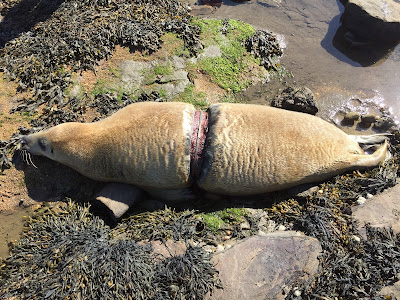 |
| Fatally entangled seal in the UK (Photo © Richard Ilderton / BDMLR) |
With Lulu's death, human involvement was a
double-edged sword. Experts claim
orca are an intelligent, agile, communicative species,
very rarely becoming entrapped. However, despite this, Lulu's ultimate cause of death was entanglement in discarded fishing line. It is speculated that the toxins within her body
may have debilitated her, impacting Lulu's ability to free herself from the lines.
Sadly, many other marine animals are killed in this way. Last
year in England, Scotland and Wales, 33 whales, seals and seabirds were found
entangled in discarded man-made materials, with a further 21 entangled marine mammals reported during the first four months of 2017. Just this Friday, Orca Aware’s sponsor charity
British Divers Marine Life Rescue attended a recently deceased young
grey seal entangled in plastic; another
indication of the sorry state of our oceans.
 |
| Recently collected in a beach clean (Photo © Suzie Hall) |
You can also take action, joining us in these five simple steps:
1. Think twice about what you buy and where possible, avoid
purchasing items wrapped in packaging.
2. Cut out "disposable" plastic items such as
straws, coffee lids, bottles and bags. Learn more about reducing your plastic
waste
here.
3. Familiarise yourself with your local recycling collection
and always try to recycle your waste.
You can also dispose of electrical items at designated sites
rather than landfills; these are ones that leak chemicals such as PCBs to the
surrounding environment.
4. Don’t litter. You wouldn’t use your sitting room floor as a
bin, so why use our planet’s floor? After all, it is all our living space.
5. Take action! Organise beach cleans and sponsored awareness events, support environmental charities and simply just spread the word. You can also encourage friends, family, colleagues and your local council to adopt more
sustainable practices.
Lulu's death symbolises our urgent need for
mindful action, to counteract the harm we have already caused through ignorance and inaction. We didn't know how PCBs and other materials would impact the oceans, but we do now. The fact can no longer be brushed under our carpet of plastic and toxic compounds.
Scientists estimate we are on the
cusp of irreversible environmental damage, with our oceans (and our world) at stake
– and
time itself may be running out. In the words of J.R.R. Tolkien, what we now "have to decide is
what to do with the time that is given us." And what we might learn from Lulu is that we need to act today.


