Showing posts with label Cetaceans. Show all posts

Tuesday, 19 March 2019

Orca of Punta Norte

by Suzie Hall

Orca Aware’s Suzie Hall, has spent the last year travelling the Americas. One of her highlights was seeing the orca of Punta Norte, within the Peninsula Valdés in Argentina. Here’s her account of the first time she witnessed their unique hunting behaviour!

Waiting at the viewpoint in Punta Norte, binoculars and camera at the ready, I could hardly believe I was about to see something I'd dreamed of for so long: The Punta Norte orca. Some five minutes before, the rangers received a radio notice that there was a group of five orca approaching from the north... 

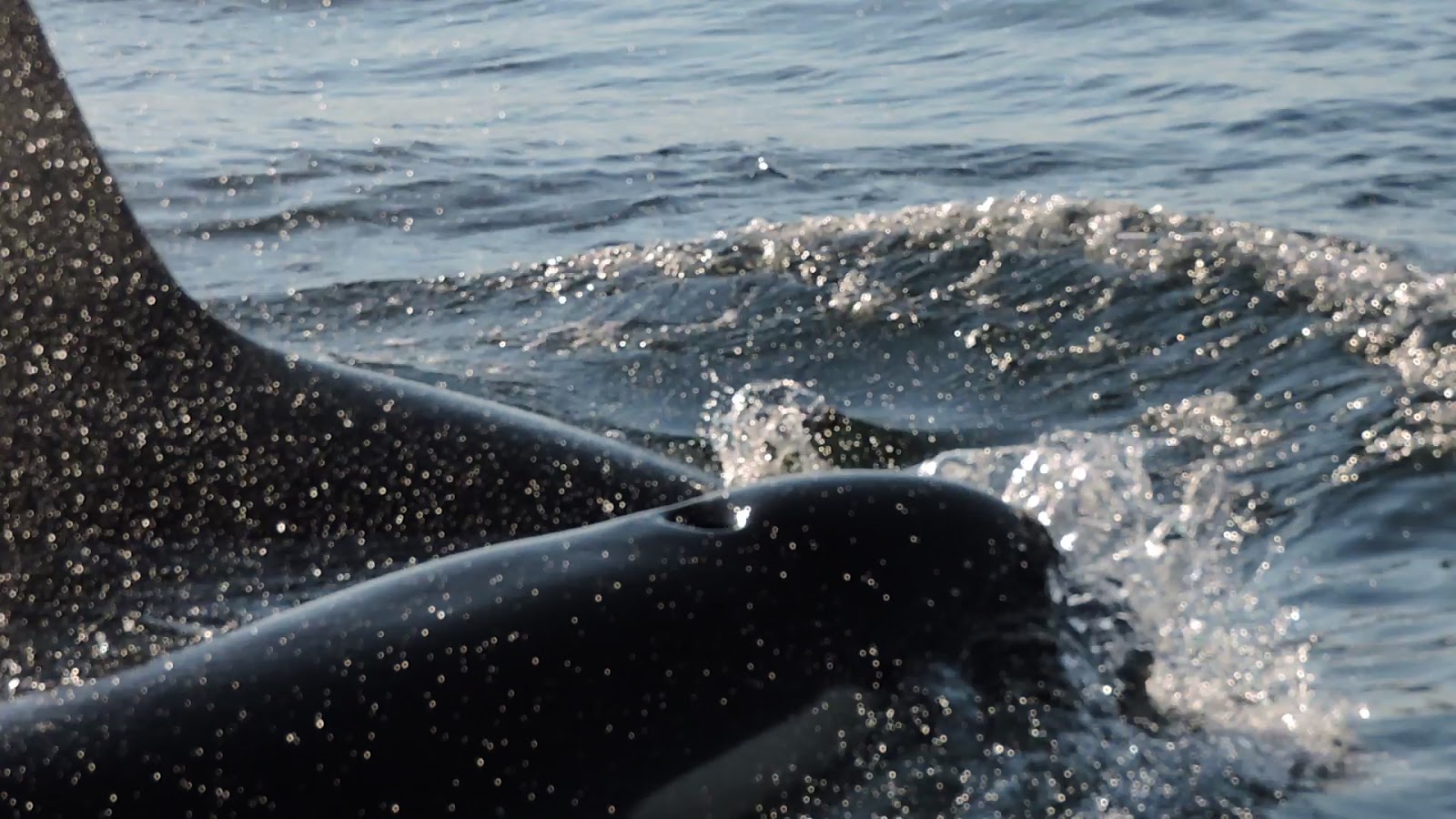
I heard them first; the unmistakable ‘pfooo’ of an orca blow, which I’ve come to recognise so well. All heads turned to spot glistening droplets of water falling gently back to the water’s surface. The chatter and excitement of the hopeful crowd had ceased in anticipatory silence, and a collective breath was held as we patiently waited. The morning light and calm skies rendered the ocean a softly undulating mirror and we caught our first sight. Two, then three, four, five unmistakable black fins carved their way through the silvery pool, as if in slow-motion. Approaching high-tide, the ocean was only 20 metres from the viewpoint, almost level with the eye, and the orca were cruising adjacent to our perch.

Suzie (right) watching the orcas from shore © pnor.org
Their dorsals grew closer, with louder 'pfoooos' echoing in quick succession as, one after the other, they each took a breath. We could see large, round heads and white eye-patches preceding smooth backs and shimmering saddle patches mere metres away. 

No one uttered a word as we watched the group swim gracefully by. For a few moments, all we heard was the orca breathing, the waves lapping at the shore and the click-click of camera shutters. It was a remarkably peaceful scene.

The Punta Norte orca are arguably one of the most distinct of all orca populations, intentionally stranding themselves to catch their prey. Only in Argentina and the Crozet Islands have orca been seen to exhibit this behaviour, and only a handful of orca in each population actually hunt using this technique. This truly makes it one of the most fascinating natural spectacles to witness. 


The orca time their arrival at these beaches with the South American sea lion and elephant seal pupping seasons. They are waiting as the pups venture away from the safety of their colonies, splashing into the water for the first time and taking their first swims along the shore. 

This particular group cruised the entire 200 metre length of the viewpoint, very close to the shore. I watched an impressively large male (called “Jaluel”) swim beside two smaller fins as they made their way south towards the “attack channel”. A group of juvenile sea lions, swimming towards the viewpoint at the same time, were frolicking lazily in the pull of the waves. They were naively unaware of the unmistakable outline and silhouette of an orca approaching from only a few tens of metres away. There was no break of the water by a dorsal fin, no audible ‘pfoooo’; just a silent, deadly figure in a single wave for a heartbeat of a second… and then it was gone.

I watched, expecting the crash – the sound of orca and pup colliding in a bloody frenzy. I watched and I waited. I watched until the pups reached the spot where the orca had been, until they were directly in front of me, until they had swum right past in a northerly direction. Disappointed, I allowed myself to take a breath. It was over before it had even begun. Or so I thought.

From the corner of my eye, I glimpsed the sharp, black edge of a dorsal fin slicing through the water, tailing the pups with increasing speed. They were closing in. As the pups sensed danger, they sped up, but it was already too late. The orca had accelerated, launching itself into the group, timing its attack perfectly with the breaking wave. There was a lot of splashing, frantic crying, and the entire body of an eight-tonne orca tore the water apart as it charged right out of the ocean and onto the sloping beach. I couldn’t tell whether it had a pup, I was too shocked and awed by the powerful display in front of me to take in all of the details.

A juvenile orca surfaced offshore followed by two more until they formed a tight-knit group again. They had the pup.

For what felt like an age, they splashed and clashed and chased their prey, taking it in turns to lurch out of the water, flip it with their mouths, slapping their tails; putting on an incredible show in their natural, wild environment. I can only imagine it didn’t play out too well for the sea lion pup, as the orca began to calm. Now satiated, they turned south to join their kin.

I remained on the peninsula just shy of a month, making my way to Punta Norte every day to see the orca. And almost every day they came. Although their feeding behaviour is well-studied and “predictable” during this season, no two days felt the same. My wonder at observing them never dwindled.

For part 2 of my Argentine adventure, I will be shining a further spotlight on this orca population and its individuals, as well as letting you know when to go and how to get there!

Monday, 8 May 2017

Learning from Lulu: The death of an orca – a sign to clean up our act?

by Suzie Hall and Sam Lipman

“One of the most contaminated individuals that we’ve ever looked at,” Dr. Andrew Brownlow told the BBC, “Possibly one of the most contaminated individuals in the world.”

Brownlow is a veterinary pathologist with Scotland’s Rural College and head of the Scottish Marine Animal Stranding Scheme (SMASS). He was referring to “Lulu” who, until her death, was a member of the UK’s only resident orca population, known as the West Coast Community. This Community is dying; there are just eight individuals left.

Lulu was found entangled on the shores of Tiree, Scotland in January of last year. A necropsy was performed on her body and the results confirm the terrifying truth: We are living beside a contaminated ocean. 

North Atlantic ecotype (Photo © Orca Aware)

A shocking 957mg/kg of polychlorinated biphenyl (PCB) contaminants were found in Lulu’s body. To put this into perspective: As little as 20-40mg/kg of PCBs are believed to cause significant physiological damage, and Lulu’s blubber contained 100 times more PCB contaminants than is the accepted toxicity threshold in marine mammals. Her blubber was packed with 957mg/kg of pure poison.

Although the production of such deadly substances is now heavily regulated, they are still leaching into the natural environment. Once there, the contaminants bio-accumulate up the food chain until the animals at the top, like orca, are carrying heavy chemical burdens. These high levels of toxicity can leave orca in poor health, infertile and in some cases, dead.

SMASS, the organisation which carried out Lulu's necropsy, reports that Lulu never produced a calf in her short lifetime; this is despite the fact she was at least 20 years old when she died. Regrettably, Lulu's pod haven’t been sighted with a calf for over two decades. It is possible that it is the impact on health and reproductive fitness from these chemicals that has sealed the fate of the culturally unique West Coast Community, setting them on a path to extinction.

Fatally entangled seal in the UK (Photo © Richard Ilderton / BDMLR)

With Lulu's death, human involvement was a double-edged sword. Experts claim orca are an intelligent, agile, communicative species, very rarely becoming entrapped. However, despite this, Lulu's ultimate cause of death was entanglement in discarded fishing line. It is speculated that the toxins within her body may have debilitated her, impacting Lulu's ability to free herself from the lines.

Sadly, many other marine animals are killed in this way. Last year in England, Scotland and Wales, 33 whales, seals and seabirds were found entangled in discarded man-made materials, with a further 21 entangled marine mammals reported during the first four months of 2017. Just this Friday, Orca Aware’s sponsor charity British Divers Marine Life Rescue attended a recently deceased young grey seal entangled in plastic; another indication of the sorry state of our oceans.  

As if PCB contamination and hazardous discarded gear aren’t bad enough news for the marine world, we are amidst a global plastic pollution crisis too. Not only does plastic also leach toxic chemicals when it breaks down, but it is estimated that by the year 2050, at current production rates, the plastic in the oceans will outweigh the fish. Along with entangling marine life, plastics have been found inside the stomachs of whales, dolphins and other animals, from whole plastic bags to tiny plastic fibres. And we’re ingesting plastic as well; up to 11,000 pieces each year, in the seafood and salt that we eat.

Recently collected in a beach clean (Photo © Suzie Hall)

While much more can and needs to be done, the outlook isn’t as murky as our polluted seas. More and more large organisations are being rallied to tackle their environmental footprint. The United Nations has pledged to take action against plastic waste, usage of PCBs and their disposal. Disposal is becoming more heavily regulated and innovations are cropping up worldwide to reduce production, consumption and circulation of these indestructible materials.

You can also take action, joining us in these five simple steps:

1. Think twice about what you buy and where possible, avoid purchasing items wrapped in packaging.

2. Cut out "disposable" plastic items such as straws, coffee lids, bottles and bags. Learn more about reducing your plastic waste here.

3. Familiarise yourself with your local recycling collection and always try to recycle your waste.

You can also dispose of electrical items at designated sites rather than landfills; these are ones that leak chemicals such as PCBs to the surrounding environment.

4. Don’t litter. You wouldn’t use your sitting room floor as a bin, so why use our planet’s floor? After all, it is all our living space.

5. Take action! Organise beach cleans and sponsored awareness events, support environmental charities and simply just spread the word. You can also encourage friends, family, colleagues and your local council to adopt more sustainable practices.

Lulu's death symbolises our urgent need for mindful action, to counteract the harm we have already caused through ignorance and inaction. We didn't know how PCBs and other materials would impact the oceans, but we do now. The fact can no longer be brushed under our carpet of plastic and toxic compounds.

Scientists estimate we are on the cusp of irreversible environmental damage, with our oceans (and our world) at stake  and time itself may be running out. In the words of J.R.R. Tolkien, what we now "have to decide is what to do with the time that is given us." And what we might learn from Lulu is that we need to act today. 

Find out more about how chemical pollution impacts orca by reading our article: Polluted Orca – How Chemicals Are Killing the World’s Killer Whales

Tuesday, 19 April 2016

The Orca of Marineland Antibes

by Sam Lipman 

Few remember Calypso. She was a six year-old orca captured from Canadian waters in December 1969. Calypso was transferred to England
and then France, where she was the first orca at Marineland Antibes. Forced to swim alone and invaded with some of the first attempts at artificial insemination, she only survived for one year. Calypso’s heart-wrenching existence served as a symbol of questionable ethics and an omen of darker things to come.

Calypso died in 1970 from an abscess on her lung. Since her death, eleven orca have died at Marineland Antibes. With the exception of Freya’s four stillborn calves, each of these individuals had their own name, given to them by their captors, and their own story. 

Clovis was the second orca to arrive at Marineland Antibes after he was captured by SeaWorld. At just two years-old, he was a victim of the horrific 1970 US Penn Cove orca captures that decimated the Southern resident population from which he originated, (the population is still endangered today).

The young calf was captured at the same time as Lolita, a female orca who is still alive today, isolated in one of the world’s smallest orca tanks at the Miami Seaquarium in Florida. In a distasteful twist over forty years later, Parques Reunidos, the company that owns Marineland Antibes, now also owns the Miami Seaquarium (and Lolita) under its US subsidiary, Palace Entertainment. Parques Reunidos itself is owned by Candover, a private equity fund managed by London-based Arle Capital Partners.

Free-ranging members of the endangered Southern resident population (Photo © Orca Aware)

When Clovis was shipped to Marineland Antibes, he was put into a tank with Calypso. Where Clovis was a Southern resident, Calypso was from the Northern resident community. “In the wild, these populations do not mix,” Howard Garrett, co-founder of the Orca Network and Free Lolita campaign remarked, adding, “Clovis and Calypso would have had no social affiliation or language similarity and it is unlikely they would have been able to socialise without sorting out their dominance roles. That could have been a violent process and one which may never have been resolved.”

Shortly after Clovis arrived at Marineland Antibes, Calypso died, leaving the young male swimming by himself for the two and a half years he survived.

Between 1976 and -89, a further five orca were captured from the wild and taken to Marineland Antibes. Kim, Betty, Kim 2, Freya and Sharkan were all Icelandic in origin. Kim was thought to be five years old when he was taken in October 1976 and he only survived for five years in confinement. Betty was three in October 1978 during her capture and she survived for a meagre nine years. Kim 2 was captured in October 1982 at less than a year old. He survived 23 years at Marineland Antibes and died without reaching the average age expected of male orca in the wild. Sharkan was the last orca to be captured from the wild and sent to Marineland Antibes. She was four years-old when she was taken in October 1989 and she only survived for nineteen years in captivity.  

Of the wild Icelandic orca captured for display at Marineland Antibes, Freya was the last to die. She was captured at the same time as Kim 2 at only one year of age. Over a period of twelve years, Freya had four stillborn calves (that we know of) and she would have been only nine or ten years old when she gave birth to the first. By orca standards, she was too young. Freya passed away in June of last year due to an alleged heart attack.

Freya at Marineland Antibes before she died (Photo © Orca Aware)

John Hargrove, a former SeaWorld orca trainer and supervisor of orca training at Marineland Antibes, saw first-hand how captivity affected several of these orca. During his time at the French park, Hargrove witnessed the orca displaying aggressive behaviours towards the trainers and he personally dealt with several severe aggressions by multiple orca in the water (you can read more about these incidents in his book ‘Beneath the Surface,’ which was released in paperback today). Hargrove also administered medication to the orca, and observed them displaying stereotypic (abnormal repetitive) behaviours due to boredom and stress.  

“One stereotypy Sharkan would display was particularly heart-breaking,” Hargrove recalled, explaining how the young orca would “isolate herself in a corner of the tank, bobbing vertically, up and down, up and down all day long as she made a noise that [he] had never heard any other orca make.” Hargrove also observed the orca swimming in repetitive patterns, obsessively burping, chewing the sides of the concrete tanks until they irreparably damaged their teeth and banging their heads against the concrete walls.

Valentin, an orca born at the park in February 1996, also displayed these self-damaging behaviours. He was Freya’s only surviving offspring and he also died last year, outliving his mother by just four months. At the time of his death, Valentin’s tank was flooded with mud from a storm that Marineland Antibes’ staff did not appear to be prepared for. This was despite the fact that there was a history of flooding in the area and that it had affected the park before. Marineland Antibes has only recently reopened its gates to the public following the 2015 flooding event and it is unclear what measures it has put in place to better protect its animals going forward.

Valentin at Marineland Antibes prior to his death (Photo © Orca Aware)

Although Valentin was the latest orca to die at Marineland Antibes, he will not be the last; four orca (and possibly a fifth, unborn) still remain. But where Calypso’s tragic death marked the start of a long trail of dead orca, Valentin brings the company full circle, dying in October, the same month of the year that his mother and all the other wild-born Icelandic orca were stolen from their native waters for display at Marineland Antibes.

The park currently has one captive-born female, Wikie (who is reportedly pregnant) and three captive-born males, Inouk, Moana and Keijo. All four animals are related and at least one is believed to be inbred. Despite this and the growing scientific evidence that orca welfare is severely compromised in captivity, Marineland Antibes has stated that, unlike SeaWorld, it will continue with its captive orca breeding programme.

“This decision shows poor leadership and a lack of vision,” Hargrove stated, going on to say that, “It is proof that Marineland Antibes is living in a world that is past and gone. The writing is clearly on the wall that the overwhelming majority do not want to see captive orca, or really any captive animals, performing tricks to line pockets.” 

An orca performing a trick at Marineland Antibes (Photo © Orca Aware)

Yvon Godefroid, founder of Belgium-based Dauphins Libres, believes that Parques Reunidos, the company that owns Marineland Antibes, should now feel “obligated to make the same change as SeaWorld in all of its parks throughout Europe and the US.” Godefroid maintains that SeaWorld’s decision to phase out orca captivity is indicative of the emerging acknowledgement that it is not ethical to keep these sentient animals in captivity. In an interview, Godefroid told Orca Aware, “This signal is loud and clear, and is the result of a changing paradigm that is being created by the way that people feel about animal welfare today.”

After perceiving how the general public’s opinion and behaviour towards orca captivity has changed in France in recent years, Godefroid believes that Marineland Antibes, as well as France’s other dolphinaria, will eventually be forced to close if they do not move away from keeping whales and dolphins. In the meantime, there is concern about how Marineland Antibes will continue breeding its orca now that genetic material from SeaWorld is no longer an option for use in its artificial insemination programme.

Godefroid explained, “It is possible that Marineland Antibes will now turn to parks with captive orca in other countries, such as South America and China, or to Russia, where wild orca are still being captured for display.” Parques Reunidos already appears to have a “cooperation agreement” with an entertainment park in China, which Arle Capital Partners announced last year.

Left to right: Wikie, Moana, Freya and Valentin at Marineland Antibes (Photo © Orca Aware)

In light of Marineland Antibes’ decision to keep breeding its orca (and other marine mammals), three organisations have teamed up to bring attention to the welfare plight that these animals are continuing to face. Orca Aware, in partnership with Dauphin Libres, US-based group Tilikum&Co, and with assistance from French organisation Code Animal, is organising a Tweetstorm event for the captives of Marineland Antibes.

“When we first started talking about doing an event for Marineland Antibes, it seemed pretty straight forward,” Haze Sommer, co-founder of Tilikum&Co, explained, “But what the research showed was a dark and insidious history with many layers, like that of an onion. Each time a layer is pulled away, another shocking revelation is exposed. What the captives of Marineland Antibes have endured is absolutely gutting and we have in excess of 200 Tweets for this event that stand testament to that fact.

Sommer believes that such social media actions are a great way to reach a lot of people, “Tweetstorms are online events where like-minded people can join together at a designated time to Tweet a page of carefully researched, pre-scripted content. The page contains a story that has been adapted for telling on Twitter.” Sommer added that with such powerful momentum in the US to move away from whale and dolphin captivity, “it is now important to take that momentum to other parts of the world. Tweetstorms are one way of doing this.”

Inouk in a tank at Marineland Antibes (Photo © Orca Aware)

When asked why people should join the Tweetstorm, Sommer said that, “With all these animals have suffered, as human spectacles and assets for greedy corporations, they’ve earned their place in history. They deserve to have their stories told and they deserve to be remembered. This Tweetstorm will be doing that for Marineland Antibes’ captives.”

Join the Tweetstorm to help tell the stories of Marineland Antibes’ orca! The event will take place at 12pm EDT (5pm BST) on Friday 22nd April, which is also this year’s Earth Day. You can find out more by visiting the Tilikum&Co Marineland Antibes Tweet sheet and by “attending” the Facebook event, where you will be provided with all of the information you need to participate.

Wednesday, 24 September 2014

Strait to the Orca! My Encounter With Gibraltar Esparte

by Sam Lipman 

I have never seen so many species of dolphin in such a short amount of time as I did during my trip to southern Spain in August. Andalucia proved to be more than I could have hoped for; a stunning location, with fantastic weather and plenty of dolphins! The waters off this coastline are thriving with marine life and I must thank Alexander Sanchez of Equinac (the marine life rescue charity based in Almeria) for introducing me to it.

Common dolphin in the Alboran Sea (Photo © Sam Lipman)
My first encounter of the week was with members of the Equinac team, surveying dolphins in the Alboran Sea. We were privileged with a fascinating opportunity to observe a large group comprising approximately 200-300 short-beaked common dolphins over several hours in their natural environment. 

I have encountered common dolphins both in Spanish and South African waters and they really are a lot of fun to watch. They are an incredibly energetic species, with an inclination for bow riding. 

Despite such a fantastic experience, I still had my heart set on seeing orca. To fulfill this ambition, I travelled to the southernmost tip of Spain, to Tarifa. Within an hour of arriving in the beautiful seaside town, I was headed straight for the orca, joining Turmares Tarifa on a boat trip out into the Strait of Gibraltar. 

It didn't take us long to find a small pod of orca, or 'esparte' as they are known in the area. The group comprised several individuals, including the female designated as 011 and known as 'Toni'.

Orca 011 'Toni' (centre) recognised by her short, wide dorsal fin (Photo © Orca Aware)

The orca found in the Strait of Gibraltar feed on tuna, using two strategies to hunt their prey. One strategy involves exhausting the fish with a 30 minute chase and the other is a fisheries interaction, where the orca take the tuna from the fishing lines. Unfortunately, we did not see the orca foraging during this trip.

They were instead observed milling around, with short bouts of slow travel. One inquisitive individual, who appeared to want to get a good look at the human spectators, started venturing close to us as our boat sat still in the water. Twice, the orca passed right underneath the vessel, swimming sideways to perhaps gain a better view. 

Orca surfacing by the boat after swimming underneath (Photo © Orca Aware)

The following day, I went out again with Turmares in the hope of encountering orca. During the morning trip, we were fortunate enough to sight all four of the resident species of dolphin in the Strait: common, striped, bottlenose, as well as pilot whales (which, like orca, are a part of the dolphin family). 

Pilot whales logging by the boat
(Photo © Orca Aware)
Our time spent with the pilot whales in the Strait was very special for me, particularly in light of my first experience with this species being at a mass stranding in Scotland (where, thankfully, the majority of the stranded whales were saved). 

During this encounter off the coast of Tarifa, a small group of whales spent time logging quietly in waters not too far away from the boat. It afforded a rare chance to study these animals visually at close proximity.

It wasn't until the afternoon, (and the final trip of my short visit to Tarifa), that I saw orca again; the fifth species of dolphin we sighted that day. The group we encountered was travelling at high speed, porpoising through the Strait. This meant we didn't spend too long with them. As I watched the orca moving off into the distance, I spent time considering what life might be like for this population. 

One of the biggest conservation threats to orca in the Strait is a reduction in food source by the fisheries. The large tanker ships moving through the narrow channel also caught my attention. I couldn't help but wonder what the noise and chemical pollutant levels are like in the Strait and how these might impact the orca and other dolphins. 

Bottlenose dolphin bow riding in a wave created by the tanker ship (Photo © Orca Aware)

The good news is that, even as recently as this August, new calves have been sighted within this orca population! 

I had a brilliant trip and I highly recommend it to anyone who has an ambition to see orca in the wild. Not only will you have a great chance of seeing orca (between July and September), you are likely to encounter other dolphin species too - and maybe even five in one day... Happy orca watching! 

A big thank you to the Sanchez family for their hospitality, and to Equinac and Turmares Tarifa for fantastic trips to watch the dolphins off the coast of Spain. 

Orca in the Strait of Gibraltar (Photo © Orca Aware)

For more information about the Strait of Gibraltar orca and other populations, visit Orca of the World.

Saturday, 26 July 2014

A Superpod at Superpod!

by Kyra Laughlin (guest blogger)

Kyra is a 19 year-old animal activist from Seattle who first entered the activist realm after watching the documentary Blackfish. She has worked on several animal rights projects at her college and within her community. In this blog, Kyra writes about her experience seeing a Southern resident orca superpod at the Superpod 3 event. 

To spectators it looked like an immense family reunion; everyone smiling or laughing and exchanging hugs. However, it wasn't blood that linked together the large group of Superpod attendees, but rather an admiration of the animal that inspired the event's name: orcas.

The week of July 14-20 marked the third Superpod gathering on San Juan Island, a compilation of daily activities aimed at bringing together researchers, activists, and orca lovers.

Members of the Southern resident orca population (Photo © Kyra Laughlin)

Superpod 3 kicked off on what is now designated as World Orca Day (July 14th) with a massive meet and greet at Friday's Crabhouse. For many, this was the first time meeting one another in person after months, if not years, of communicating through email and Facebook, but it didn't take long for these virtual friendships to translate in real life.

All four former SeaWorld trainers and founders of Voice of the Orcas, Carol Ray, Jeff Ventre, Samantha Berg, and John Jett, were present, as well as the Director of the Center for Whale Research, Ken Balcomb, and Orca Network co-founder, Howard Garrett. 

These six remarkable individuals were cast members in the highly-acclaimed documentary Blackfish which explores the various issues of keeping orcas, who are profoundly intelligent and social beings, in captivity. Blackfish was filmed at both Superpod 1 and 2, after Jeff Ventre suggested the "Truth Squad" gather to see orcas in the wild. These meetings also served as a great spot for author David Kirby to gather material for his book Death at SeaWorld. The book provides a more in depth look at the history of orca captivity, following those who advocate on the animals' behalf, with a particular focus on the life work of renowned marine mammal scientist, Naomi Rose.

While everyone continued to mingle at the restaurant, a group of us departed early for a whale watch trip that would soon go down in the history books.


Southern resident orca L86, 'Surprise' (Photo © Kyra Laughlin)

I had only seen my first Southern resident killer whale two days prior from shore at San Juan County Park and although the previous day's whale watch excursion had been impressive, nothing could compare to this memorable encounter we were about to embark on.

Within 20 minutes of leaving Snug Harbor, we found our boat in the middle of a never-ending orca parade that included all three Southern resident pods: J,K, and L. They were gathered together in what is known as a 'superpod' (hence the name of the event). Just as one group disappeared beneath the horizon another would soon arrive. We saw them breach, spy hop, tail slap, and one, known as ‘Surprise’ and identified as L86, even porpoised four times, which provided a clear scale of how humongous these creatures truly are. The sheer size of this orca as she leapt into the air was striking, not to mention the loud splash that resonated each time she retreated back into the ocean, as a huge wall of water rose from the surface to encompass her black and white body.

There were moments when it looked as though one of the pods was headed straight toward us. We held our breath waiting for them to appear next to the vessel, but they always managed to surface several yards out from either side of the boat.

When the action began to die down, we slowly made our way deeper into Haro Strait. Boats began to show up from every direction as news spread that a superpod was gathering - the "podparazzi" had arrived.


In 2005, the Southern resident killer whale population were listed as endangered under the US Endangered Species Act. Noise pollutants and boat crowding are two conservation risks for the Southern resident killer whales. Exclusion zones (areas into which entry is forbidden by watercraft) have been put in place to protect the orcas and minimize disturbance to their natural behaviors. These guidelines for careful boat handling around Southern resident orcas can be found clearly detailed by the Pacific Whale Watch Association.

A video screenshot of the Southern resident orca (Photo © Kyra Laughlin)

The captain shut off the engine knowing the orcas were close. For a brief moment we were able to take in the view. The sun hung low in the sky but continued to cast a shimmering gleam on the calm sea below. It was peaceful; gently rocking back and forth with the ocean, but within minutes we were back in orca mode.

We again found ourselves in the same area as a group of 5-7 orcas. I scrambled to set up my camera as it soon became evident that this time they were going to swim right by us. I began shooting a video. It didn't take long for a dorsal to emerge, followed by a misty trail of breath.

Here I was, seeing Southern residents for only my third time and I had beads of whale breath on my face. The emotions that rush over you in a moment like that cannot be put into words and I'm not even sure if that experience will ever fully sink in; it left me in pure disbelief.

We stayed on the water for a while longer and continued to watch in awe as the pods gathered together, just as their human observers had done a few short hours ago.

On the ride back to Snug Harbor, I was still trying to process all that we had seen. The number of whales we saw on that trip, (well over 30), had been what I had expected to see over the course of the week - not in a single three hour excursion.

It was a superpod at Superpod!


Left to Right: Jeff Ventre, Heather Murphy, Jordan Waltz, Kyra Laughlin
& Ken Balcomb at Superpod 3 (Photo © Heather Murphy)

Sunday, 9 March 2014

Icelandic Orca In Captivity

Information Resource by Orca Aware


Orca Currently Alive

Stella
Stella was around the age of one when she was captured in 1987 and is on display at the Port of Nagoya Aquarium in Japan. Up until 02 August 2014, Stella resided with another wild-caught Icelandic orca, Bingo (also known as Thor). Stella and Bingo produced four surviving calves: Lovey (born 1998), Lara (born 2001), Ran 2 (born 2006) and Rin (also known as Lynn, born 2012). Their third calf, Sarah, lived from May 2003 until April 2006. 

Kiska
Kiska was captured in 1979 at the age of three and is currently the only orca kept at Marineland Ontario in Canada. Kiska has produced five calves, all of which are dead. The longest-living calf died at age six and the shortest-living calf only survived for 62 days. 

Ulises
Ulises was around three years-old when captured from Icelandic waters. Ulises was captured in 1980 and is now held at SeaWorld in California. He suffers from flaccid fin syndrome & prior to SeaWorld's breeding ban, was used as a breeding bull, including to impregnate a captive orca at Marineland Antibes in France. Ulises has sired two calves (although it is unconfirmed whether he is the father of the first calf in France).

Katina
Katina (also known as Kandu 6) is contained at SeaWorld in Florida. Katina was captured in 1978 at the age of two. Katina has four surviving calves, of which only two are at SeaWorld Florida with her. Three more of her captive-born offspring have died. 

A further 49 orca were captured from Icelandic waters (that we know of). Of these, 48 individuals have died in captivity, with only one female surviving past the age of 30 in the captive environment. The majority of these Icelandic orca have survived in captivity for considerably less time, with several having died after only a few months.  

Name, Age at Capture, Time in Captivity: 

Kim, 5 years, 1976 - 1982
Kenau, 1 year, 1976 - 1991
Gudrun, <1 year, 1976 - 1996
Magnus, 1 year, 10/1977 - 12/1977
Canuck 2, 2 years, 1977 - 1981
Koana 2, 2 years, 1977 - 1987
Kandu 5, 3 years, 1977 - 1989
Suzie Wong, <1 year, 1977 - 1997
Winnie, <1 year, 1977 - 2002
No name, 1 year, 10/1978 - 02/1979
Shawn, 1 year, 1978 - 1979
Betty, 3 years, 1978 - 1987
Kahana, 1 year, 1978 - 1991
Kotar, <1 year, 1978 - 1995
No name, 1 year, 11/1978 - 02/1979
Kasatka, 1 year, 1978 - 2017
Shamu, 1 year, 1979 - 1983
No name, 3 years, 11/1979 - 01/1980
King, <1 year, 1979 - 1983
Caren, 2 years, 1979 - 1987
Benkei 2, <1 year, 1980 - 1983
Finna, 3 years, 1980 - 1997
Vigga, 1 year, 1980 - 2000
Bjossa, 3 years, 1980 - 2001
No name, 4 years, 10/1981 - 1982? 
No name, <1 year, 10/1981 - 12/1981
Neptune, 4 years, 1981 - 1983
Nemo, <1 year, 1981 - 1986
Ruka, 2 years, 1981 - 2000
Nootka 5, 2 years, 1981 - 2008
No name, 1 year, 10/1982 - 05/1983
Nootka 4, 3 years, 1982 - 1994
Haida 2, <1 year, 1982 - 2001
Kim 2, <1 year, 1982 - 2005
Freya, 1 year, 1982 - 2015
Nandu, 2 years, 1983 - 1988
Samoa, 3 years, 1983 - 1992
Tilikum, 2 years, 1983 - 2017
No name, 4 years, 11/1984 - 01/1985
Bingo, 2 years, 1984 - 2014
Freyja, 2 years, 1984 - 1987
Junior, 2 years, 1984 - 1994
Kandu 7, 6 years, 1984 - 2005
Prince, 3 years, 1987 - 1991
Maggie, 3 years, 1987 - 1997
Oscar, 1 year, 1987 - 2012
Ai, 1-2 years, 1989 - 1995
Tanouk, 3 years, 1989 - 2000
Ran, 1-2 years, 1989 - 2004
Sharkan, 4 years, 1989, 1989 - 2009

Keiko, 2 years, 1979 - Keiko died in 2003 after being returned to his natural habitat. 

For more information, visit: ORCA HOME (www.orcahome.de)