by Suzie Hall
Ever since I can remember,
I’ve wanted to work with orcas. Admittedly, my childhood dream was to ride
around on the back of my orca best friend in a very ‘
Free Willy’-esque fashion,
but as I’ve grown older the dream has been reworked into something more
realistic. Over the years, there has been more and more evidence to show that
keeping orcas in captivity causes them
physical and psychological damage. Whilst the
debate between experts and the industry still rages, and marine parks either
move forward or continue to defend their decision to keep captive orcas, my mind is set: These
creatures should be kept out of tanks and free to hunt, travel and socialise in
the wild. That’s where the research should be done, and that’s what I want to
do.
Over the past few years
I’ve crammed in as many qualifications, courses and lectures as I can manage in
an attempt to make myself useful within the world of orca research and
conservation. I have
still never seen
an orca in the flesh, which is becoming a bit embarrassing given my
not-so-subtle obsession.
Five months ago, I received
an email from
Dr. Paul Spong and his wife, Helena
Symonds, inviting me to visit their research station,
OrcaLab, off the coast of British Colombia, Canada. To say I was excited
is an understatement, (I was so excited I managed to tell everyone I was going
to visit without
actually emailing
back to accept their offer!). And now I am finally beginning my mega journey from
the UK to the northern coast of Vancouver Island – a 72+ hour journey.
So what does one need to
pack for a summer of orca research?
Due to a stellar effort by
myself, my family and the Internet, I’m now confident that I have everything I
need…
- Binoculars? Check.
- Camera? Check.
- Sleeping bag? Check.
- Clothes for sunshine and torrential downpours? Check.
- Mini cafetière to keep the morning monster at bay? Ch-
Ah. Forgot that one.
In addition to my giant
backpack, (which has its own mini backpack), I’m also transporting all
20kgs of my SCUBA diving kit to the island to assist with maintenance of the
underwater cameras and microphones. In hindsight, attempting to carry 40kgs of
luggage on a three-day journey, complete with a long-haul flight, an overnight
stay in a hostel, a ten-hour bus journey and two ferry crossings may have been slightly optimistic… But
it’s too late now. Let’s hope someone on the team is a trained masseuse.
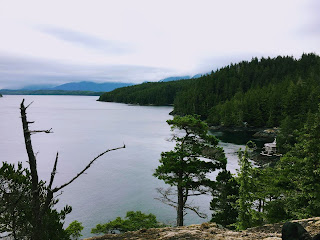
OrcaLab is situated on
Hanson Island, a largely uninhabited island off the north-eastern coast of
Vancouver Island. Over the summer months, Paul, Helena and their team monitor
the
Northern resident orcas that inhabit the
area, along with the humpback whales that also frequent the Straits. The
transient (or ‘Biggs’) orcas are also studied as they often make an
appearance in the area to
predate on smaller mammals. The lab includes a
network of hydrophones (underwater microphones) covering about 50km of the
orcas' habitat, which collect
acoustic data and photographic images 24
hours a day.
And OrcaLab is completely
off-grid: powered by solar panels and generators. This means that any luxuries
are few-and-far between; we’ll be travelling to the nearest town (Alert Bay, on
a neighbouring island) every 1-2 weeks for food and laundry.
 |
| Photo © Max Woodman |
OrcaLab is a unique research station and the work it conducts is essential for the preservation of orcas and
other marine wildlife. For me, this is the experience of a lifetime and, I
hope, the first of many orca-related projects. I cannot think of a better place
to see my first orcas than among the verdant islands of British Colombia, and I
hope that I will prove myself useful to the research at OrcaLab. I would also
love to see orca ‘
Springer’ who is part of the Northern resident community, as she is the
first orca I adopted at the tender age of nine. Springer has also just been
spotted with her second calf following her release back into the wild fifteen years ago, after she was rescued.
Over the next few months I
will be sharing my experience of OrcaLab, the orcas and the beautiful coast of
British Colombia - so stay tuned!
For a short history of OrcaLab and its research, please read our interview with Dr. Paul Spong.


