Showing posts with label Education. Show all posts

Thursday, 11 June 2020

The World's Greatest Alarm Clock: An audio experience transporting you to the home of the Northern resident orca

by Megan Hockin-Bennett 


Introduction by Sam Lipman:
Megan observing orca at OrcaLab
Megan Hockin-Bennett, talented wildlife videographer and founder of Wild Sky Productions, has spent eight years studying the Northern resident orca with OrcaLab in Vancouver, Canada. Using a network of underwater hydrophones and cameras, alongside land-based identification, Megan assists the station in conducting its vital research, increasing insight into the lives of the unique Northern resident community (as well as working to help wild-captured Northern resident orca Corky). 

For Orca Month, Megan has crafted her knowledge, experiences and orca recordings into a special encounter that brings the orca to you...

In this magical audio experience, Megan invites you to spend a peaceful moment with her on the shores of the Johnstone Strait, listening to the haunting calls of the orca families who inhabit it. You will walk (or float) away feeling relaxed, educated and refreshed. 

So take a break, get comfortable, close your eyes - or turn on OrcaLab's live cameras to try and catch a glimpse of the orca - and let yourself be transported to the home of the Northern residents. 

We hope you enjoy! 


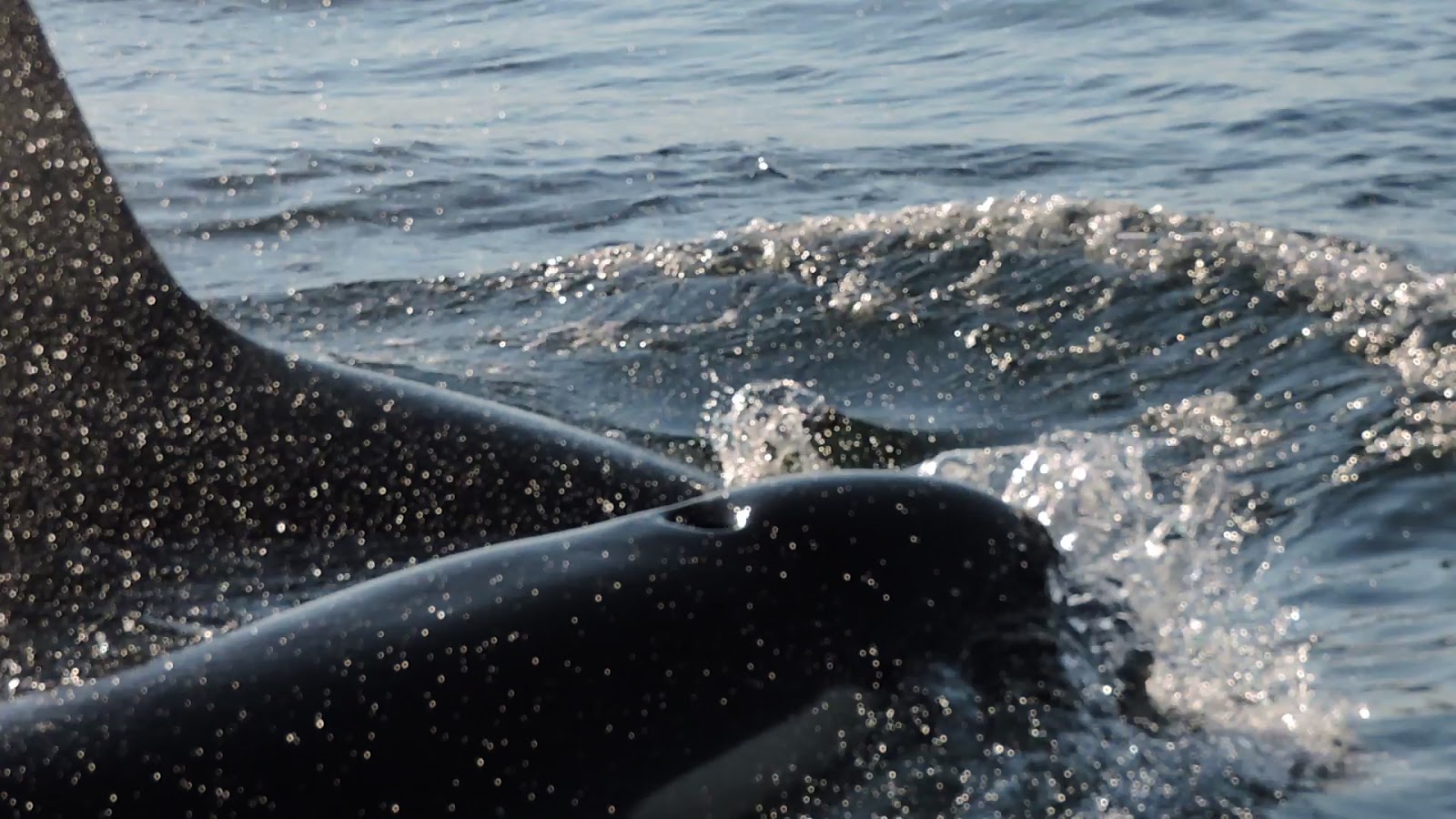
Male transient orca T019B / Galliano passes Megan at OrcaLab

For more of Megan's videos, visit Wild Sky Productions.

You can also head over to OrcaLab to learn more about the Northern resident orca, staying up-to-date through its Facebook and Instagram pages. 

Keep spreading the word about how to help care for, protect and conserve our world's orca during (and after) Orca Month.

And if you spot any orca on OrcaLab's live cameras, let us know - happy orca watching! 


Monday, 8 May 2017

Learning from Lulu: The death of an orca – a sign to clean up our act?

by Suzie Hall and Sam Lipman

“One of the most contaminated individuals that we’ve ever looked at,” Dr. Andrew Brownlow told the BBC, “Possibly one of the most contaminated individuals in the world.”

Brownlow is a veterinary pathologist with Scotland’s Rural College and head of the Scottish Marine Animal Stranding Scheme (SMASS). He was referring to “Lulu” who, until her death, was a member of the UK’s only resident orca population, known as the West Coast Community. This Community is dying; there are just eight individuals left.

Lulu was found entangled on the shores of Tiree, Scotland in January of last year. A necropsy was performed on her body and the results confirm the terrifying truth: We are living beside a contaminated ocean. 

North Atlantic ecotype (Photo © Orca Aware)

A shocking 957mg/kg of polychlorinated biphenyl (PCB) contaminants were found in Lulu’s body. To put this into perspective: As little as 20-40mg/kg of PCBs are believed to cause significant physiological damage, and Lulu’s blubber contained 100 times more PCB contaminants than is the accepted toxicity threshold in marine mammals. Her blubber was packed with 957mg/kg of pure poison.

Although the production of such deadly substances is now heavily regulated, they are still leaching into the natural environment. Once there, the contaminants bio-accumulate up the food chain until the animals at the top, like orca, are carrying heavy chemical burdens. These high levels of toxicity can leave orca in poor health, infertile and in some cases, dead.

SMASS, the organisation which carried out Lulu's necropsy, reports that Lulu never produced a calf in her short lifetime; this is despite the fact she was at least 20 years old when she died. Regrettably, Lulu's pod haven’t been sighted with a calf for over two decades. It is possible that it is the impact on health and reproductive fitness from these chemicals that has sealed the fate of the culturally unique West Coast Community, setting them on a path to extinction.

Fatally entangled seal in the UK (Photo © Richard Ilderton / BDMLR)

With Lulu's death, human involvement was a double-edged sword. Experts claim orca are an intelligent, agile, communicative species, very rarely becoming entrapped. However, despite this, Lulu's ultimate cause of death was entanglement in discarded fishing line. It is speculated that the toxins within her body may have debilitated her, impacting Lulu's ability to free herself from the lines.

Sadly, many other marine animals are killed in this way. Last year in England, Scotland and Wales, 33 whales, seals and seabirds were found entangled in discarded man-made materials, with a further 21 entangled marine mammals reported during the first four months of 2017. Just this Friday, Orca Aware’s sponsor charity British Divers Marine Life Rescue attended a recently deceased young grey seal entangled in plastic; another indication of the sorry state of our oceans.  

As if PCB contamination and hazardous discarded gear aren’t bad enough news for the marine world, we are amidst a global plastic pollution crisis too. Not only does plastic also leach toxic chemicals when it breaks down, but it is estimated that by the year 2050, at current production rates, the plastic in the oceans will outweigh the fish. Along with entangling marine life, plastics have been found inside the stomachs of whales, dolphins and other animals, from whole plastic bags to tiny plastic fibres. And we’re ingesting plastic as well; up to 11,000 pieces each year, in the seafood and salt that we eat.

Recently collected in a beach clean (Photo © Suzie Hall)

While much more can and needs to be done, the outlook isn’t as murky as our polluted seas. More and more large organisations are being rallied to tackle their environmental footprint. The United Nations has pledged to take action against plastic waste, usage of PCBs and their disposal. Disposal is becoming more heavily regulated and innovations are cropping up worldwide to reduce production, consumption and circulation of these indestructible materials.

You can also take action, joining us in these five simple steps:

1. Think twice about what you buy and where possible, avoid purchasing items wrapped in packaging.

2. Cut out "disposable" plastic items such as straws, coffee lids, bottles and bags. Learn more about reducing your plastic waste here.

3. Familiarise yourself with your local recycling collection and always try to recycle your waste.

You can also dispose of electrical items at designated sites rather than landfills; these are ones that leak chemicals such as PCBs to the surrounding environment.

4. Don’t litter. You wouldn’t use your sitting room floor as a bin, so why use our planet’s floor? After all, it is all our living space.

5. Take action! Organise beach cleans and sponsored awareness events, support environmental charities and simply just spread the word. You can also encourage friends, family, colleagues and your local council to adopt more sustainable practices.

Lulu's death symbolises our urgent need for mindful action, to counteract the harm we have already caused through ignorance and inaction. We didn't know how PCBs and other materials would impact the oceans, but we do now. The fact can no longer be brushed under our carpet of plastic and toxic compounds.

Scientists estimate we are on the cusp of irreversible environmental damage, with our oceans (and our world) at stake  and time itself may be running out. In the words of J.R.R. Tolkien, what we now "have to decide is what to do with the time that is given us." And what we might learn from Lulu is that we need to act today. 

Find out more about how chemical pollution impacts orca by reading our article: Polluted Orca – How Chemicals Are Killing the World’s Killer Whales

Saturday, 26 July 2014

A Superpod at Superpod!

by Kyra Laughlin (guest blogger)

Kyra is a 19 year-old animal activist from Seattle who first entered the activist realm after watching the documentary Blackfish. She has worked on several animal rights projects at her college and within her community. In this blog, Kyra writes about her experience seeing a Southern resident orca superpod at the Superpod 3 event. 

To spectators it looked like an immense family reunion; everyone smiling or laughing and exchanging hugs. However, it wasn't blood that linked together the large group of Superpod attendees, but rather an admiration of the animal that inspired the event's name: orcas.

The week of July 14-20 marked the third Superpod gathering on San Juan Island, a compilation of daily activities aimed at bringing together researchers, activists, and orca lovers.

Members of the Southern resident orca population (Photo © Kyra Laughlin)

Superpod 3 kicked off on what is now designated as World Orca Day (July 14th) with a massive meet and greet at Friday's Crabhouse. For many, this was the first time meeting one another in person after months, if not years, of communicating through email and Facebook, but it didn't take long for these virtual friendships to translate in real life.

All four former SeaWorld trainers and founders of Voice of the Orcas, Carol Ray, Jeff Ventre, Samantha Berg, and John Jett, were present, as well as the Director of the Center for Whale Research, Ken Balcomb, and Orca Network co-founder, Howard Garrett. 

These six remarkable individuals were cast members in the highly-acclaimed documentary Blackfish which explores the various issues of keeping orcas, who are profoundly intelligent and social beings, in captivity. Blackfish was filmed at both Superpod 1 and 2, after Jeff Ventre suggested the "Truth Squad" gather to see orcas in the wild. These meetings also served as a great spot for author David Kirby to gather material for his book Death at SeaWorld. The book provides a more in depth look at the history of orca captivity, following those who advocate on the animals' behalf, with a particular focus on the life work of renowned marine mammal scientist, Naomi Rose.

While everyone continued to mingle at the restaurant, a group of us departed early for a whale watch trip that would soon go down in the history books.


Southern resident orca L86, 'Surprise' (Photo © Kyra Laughlin)

I had only seen my first Southern resident killer whale two days prior from shore at San Juan County Park and although the previous day's whale watch excursion had been impressive, nothing could compare to this memorable encounter we were about to embark on.

Within 20 minutes of leaving Snug Harbor, we found our boat in the middle of a never-ending orca parade that included all three Southern resident pods: J,K, and L. They were gathered together in what is known as a 'superpod' (hence the name of the event). Just as one group disappeared beneath the horizon another would soon arrive. We saw them breach, spy hop, tail slap, and one, known as ‘Surprise’ and identified as L86, even porpoised four times, which provided a clear scale of how humongous these creatures truly are. The sheer size of this orca as she leapt into the air was striking, not to mention the loud splash that resonated each time she retreated back into the ocean, as a huge wall of water rose from the surface to encompass her black and white body.

There were moments when it looked as though one of the pods was headed straight toward us. We held our breath waiting for them to appear next to the vessel, but they always managed to surface several yards out from either side of the boat.

When the action began to die down, we slowly made our way deeper into Haro Strait. Boats began to show up from every direction as news spread that a superpod was gathering - the "podparazzi" had arrived.


In 2005, the Southern resident killer whale population were listed as endangered under the US Endangered Species Act. Noise pollutants and boat crowding are two conservation risks for the Southern resident killer whales. Exclusion zones (areas into which entry is forbidden by watercraft) have been put in place to protect the orcas and minimize disturbance to their natural behaviors. These guidelines for careful boat handling around Southern resident orcas can be found clearly detailed by the Pacific Whale Watch Association.

A video screenshot of the Southern resident orca (Photo © Kyra Laughlin)

The captain shut off the engine knowing the orcas were close. For a brief moment we were able to take in the view. The sun hung low in the sky but continued to cast a shimmering gleam on the calm sea below. It was peaceful; gently rocking back and forth with the ocean, but within minutes we were back in orca mode.

We again found ourselves in the same area as a group of 5-7 orcas. I scrambled to set up my camera as it soon became evident that this time they were going to swim right by us. I began shooting a video. It didn't take long for a dorsal to emerge, followed by a misty trail of breath.

Here I was, seeing Southern residents for only my third time and I had beads of whale breath on my face. The emotions that rush over you in a moment like that cannot be put into words and I'm not even sure if that experience will ever fully sink in; it left me in pure disbelief.

We stayed on the water for a while longer and continued to watch in awe as the pods gathered together, just as their human observers had done a few short hours ago.

On the ride back to Snug Harbor, I was still trying to process all that we had seen. The number of whales we saw on that trip, (well over 30), had been what I had expected to see over the course of the week - not in a single three hour excursion.

It was a superpod at Superpod!


Left to Right: Jeff Ventre, Heather Murphy, Jordan Waltz, Kyra Laughlin
& Ken Balcomb at Superpod 3 (Photo © Heather Murphy)

Sunday, 9 March 2014

Icelandic Orca In Captivity

Information Resource by Orca Aware


Orca Currently Alive

Stella
Stella was around the age of one when she was captured in 1987 and is on display at the Port of Nagoya Aquarium in Japan. Up until 02 August 2014, Stella resided with another wild-caught Icelandic orca, Bingo (also known as Thor). Stella and Bingo produced four surviving calves: Lovey (born 1998), Lara (born 2001), Ran 2 (born 2006) and Rin (also known as Lynn, born 2012). Their third calf, Sarah, lived from May 2003 until April 2006. 

Kiska
Kiska was captured in 1979 at the age of three and is currently the only orca kept at Marineland Ontario in Canada. Kiska has produced five calves, all of which are dead. The longest-living calf died at age six and the shortest-living calf only survived for 62 days. 

Ulises
Ulises was around three years-old when captured from Icelandic waters. Ulises was captured in 1980 and is now held at SeaWorld in California. He suffers from flaccid fin syndrome & prior to SeaWorld's breeding ban, was used as a breeding bull, including to impregnate a captive orca at Marineland Antibes in France. Ulises has sired two calves (although it is unconfirmed whether he is the father of the first calf in France).

Katina
Katina (also known as Kandu 6) is contained at SeaWorld in Florida. Katina was captured in 1978 at the age of two. Katina has four surviving calves, of which only two are at SeaWorld Florida with her. Three more of her captive-born offspring have died. 

A further 49 orca were captured from Icelandic waters (that we know of). Of these, 48 individuals have died in captivity, with only one female surviving past the age of 30 in the captive environment. The majority of these Icelandic orca have survived in captivity for considerably less time, with several having died after only a few months.  

Name, Age at Capture, Time in Captivity: 

Kim, 5 years, 1976 - 1982
Kenau, 1 year, 1976 - 1991
Gudrun, <1 year, 1976 - 1996
Magnus, 1 year, 10/1977 - 12/1977
Canuck 2, 2 years, 1977 - 1981
Koana 2, 2 years, 1977 - 1987
Kandu 5, 3 years, 1977 - 1989
Suzie Wong, <1 year, 1977 - 1997
Winnie, <1 year, 1977 - 2002
No name, 1 year, 10/1978 - 02/1979
Shawn, 1 year, 1978 - 1979
Betty, 3 years, 1978 - 1987
Kahana, 1 year, 1978 - 1991
Kotar, <1 year, 1978 - 1995
No name, 1 year, 11/1978 - 02/1979
Kasatka, 1 year, 1978 - 2017
Shamu, 1 year, 1979 - 1983
No name, 3 years, 11/1979 - 01/1980
King, <1 year, 1979 - 1983
Caren, 2 years, 1979 - 1987
Benkei 2, <1 year, 1980 - 1983
Finna, 3 years, 1980 - 1997
Vigga, 1 year, 1980 - 2000
Bjossa, 3 years, 1980 - 2001
No name, 4 years, 10/1981 - 1982? 
No name, <1 year, 10/1981 - 12/1981
Neptune, 4 years, 1981 - 1983
Nemo, <1 year, 1981 - 1986
Ruka, 2 years, 1981 - 2000
Nootka 5, 2 years, 1981 - 2008
No name, 1 year, 10/1982 - 05/1983
Nootka 4, 3 years, 1982 - 1994
Haida 2, <1 year, 1982 - 2001
Kim 2, <1 year, 1982 - 2005
Freya, 1 year, 1982 - 2015
Nandu, 2 years, 1983 - 1988
Samoa, 3 years, 1983 - 1992
Tilikum, 2 years, 1983 - 2017
No name, 4 years, 11/1984 - 01/1985
Bingo, 2 years, 1984 - 2014
Freyja, 2 years, 1984 - 1987
Junior, 2 years, 1984 - 1994
Kandu 7, 6 years, 1984 - 2005
Prince, 3 years, 1987 - 1991
Maggie, 3 years, 1987 - 1997
Oscar, 1 year, 1987 - 2012
Ai, 1-2 years, 1989 - 1995
Tanouk, 3 years, 1989 - 2000
Ran, 1-2 years, 1989 - 2004
Sharkan, 4 years, 1989, 1989 - 2009

Keiko, 2 years, 1979 - Keiko died in 2003 after being returned to his natural habitat. 

For more information, visit: ORCA HOME (www.orcahome.de)

Sunday, 12 August 2012

But we don't even have orca in the UK...

by Sam Lipman 

Yes we do.

In fact, it always surprises me when I come across someone who doesn't realise we have any cetaceans (whales, dolphins and porpoises) around our UK coastline. We have over 25 species!

And they are readily accessible - even orca! In fact, they have made such an appearance over the last couple of months that they've made it into national news. The BBC have published articles about them and there's a Daily Mail piece reporting the sighting of fourteen orca in the harbour at John O'Groats in Scotland in July (that's less than a month ago!).

We even have a small 'resident' pod living in waters off the West Coast of Scotland dubbed the West Coast Community. The entire West Coast Community is comprised of less than ten individuals.

Orca Aware has been launched in order to make you aware that we do have killer whales around the UK coastline and in most of our world's seas and oceans. Why is this important? Because it shows us just how close to home this amazing species is - where you are!

We should care about orca, we should learn about them and we should help address the conservation threats that they face.

The IUCN Red List entry for orca illustrates just how wide-ranging this species is and it is a great place to begin when looking for answers. You can also visit our Orca of the World blog for profiles of many of the world's known orca populations and the researchers who are studying them.

Over the coming weeks and months, follow Orca Aware to learn more about orca, the different populations and orca cultures found around the world, their physiology, behaviour and intelligence, different problems that they each face, how we study them and how you yourself can get involved with working with wild orca.

We look forward to hearing from you!